“God is dead, and we have killed him,” Nietzsche said, and humanity nodded in disapproval. We announced the death of our Creator to free ourselves from gods once and for all, but then went ahead and created artificial gods and chained ourselves to them.
“When god is proclaimed dead, he returns in a whole series of pseudo-atheist shapes,” Slavoj Zizek writes in Christian Atheism. However, the god that returns is a simulacrum and not the original God. It is a new (or another) god that fills the void of a dead god…
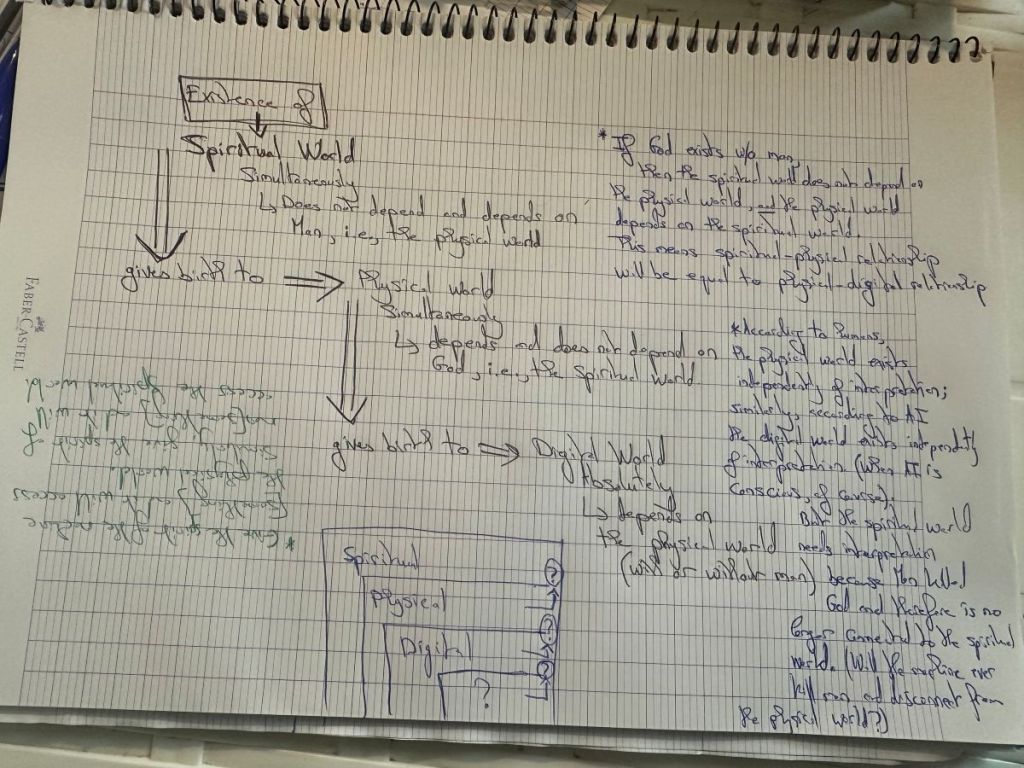
Resurrecting the original God will (re)open a dimension that non-humans cannot access. This dimension is an (inter)subjective, ((inter)+(intra))personal space outside of physical and digital space, and it contains the (spiritual) realm of God, whose breath is nothing other than the spirit of humanity. At the entrance of this place, there is a sign that reads, “No Soul, No Entry.” And it comforts us profoundly when we read it. Only humans can enter this place. Machines cannot follow us here.
Although this (re)opened spiritual dimension transcends the physical and digital worlds, and although it may not even exist[!] in ‘reality’, it still has the power to influence the universe we breathe in. [The force that created all things is also the force that can destroy everything, including all possible futures.] We are not crawling back to God to hide in religion’s skirt. On the contrary, we are preparing for war against the machine-god. We want to (re)shape the future before it’s too late.
“Why are we bringing back God?” is the question.
The answer is: “We want the God who created us to save us from the god we created.”
Quotes
To program a friendly AI, we need to capture the meaning of life. What’s “meaning”? What’s “life”? What’s the ultimate ethical imperative? In other words, how should we strive to shape the future of our Universe? If we cede control to a superintelligence before answering these questions rigorously, the answer it comes up with is unlikely to involve us. This makes it timely to rekindle the classic debates of philosophy and ethics, and adds a new urgency to the conversation!
– Max Tegmark, Life 3.0
If something resembling “post-humanity” will effectively emerge as a massive fact, then all three (overlapping) moments of our spontaneous world-view (humans, gods, nature) will disappear. Our being-human can only exist against the background of impenetrable nature, and if — through bio-genetic science and practices — life becomes something that can be technologically fully manipulated, human and natural life lose their “natural” character. And the same holds for god: what humans (always in historically specified forms) experience as “god” is something that has meaning only from the standpoint of human finitude and mortality — “God” is a counterpart of the terrestrial finitude, so once we become homo deus and acquire properties which seem “supernatural” from our old human standpoint (like directly communicating with other conscious beings or with AI), “Gods” are we know them disappear. The tech-gnostic visions of a post-human world are ideological fantasies that obfuscate the abyss of what awaits us.
– Slavoj Zizek, Christian Atheism
Discover more from Bored Absurdist
Subscribe to get the latest posts sent to your email.
 Bored Absurdist
notable that every theist is sure that only they have the “original” and not one can show that this is true.
LikeLike
Not sure if you really read the text. No dogmas here. But thanks for the comment.
LikeLike
plenty of dogma, including that you and only you know the “real” god.
LikeLike
On the contrary, I believe that your god is as real or as unreal as mine, whichever you prefer. Have a nice day.
LikeLike
unsurprsingly, that’s not what you wrote.
LikeLike
Have you considered that the problem might be your one-dimensional thinking and inability to comprehend the text?
Or maybe you’re just having fun keeping this thread alive…
LikeLike
ROFL. That’s great, Chris. “Resurrecting the original God will (re)open a dimension that non-humans cannot access. ”
always fun when cultists make up baseless nonsense and declare that only their god is the right one.
LikeLike
Ahh, I see what happened there. The “original God” refers to original in comparison to the simulacrum. (Check the paragraph before it.) It’s not about a specific deity. I hope this clarifies things. Cheers,
LikeLike
ROFL. Yep, ever so sure you have the “right” god, and no evidence at all that any gods exist, or that any “simulacrum” exists.
LikeLike