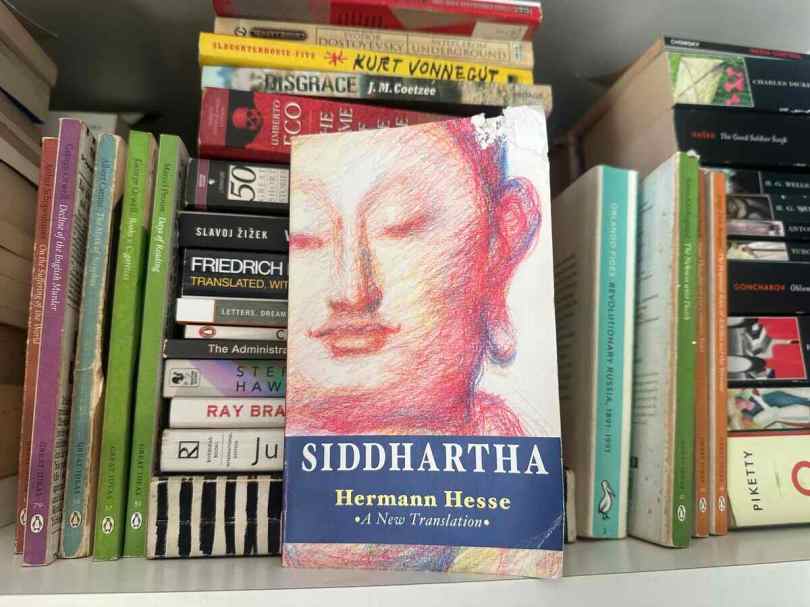
Hermann Hesse’s Siddhartha is one of those books everyone must read. Not only because it’s a classic, nor because Hesse is the winner of the 1946 Nobel Prize in literature, but because reading Siddhartha will make the reader, whoever he is, (a tiny bit) wiser (even if he doesn’t plan on becoming a Buddhist).
Where Buddha and Nietzsche Briefly Meet
Sitting at my desk in my study, the book in my hands, I’m thinking about this quote:
Seeking means having a goal, but finding means being free, open, having no goal.
– Hermann Hesse, Siddhartha
Having a goal chains you to it…
Have no goal unchains you…
The goal is a target; to hit the target, one must aim at it; to aim at a target, one must focus on it alone; therefore, the person who has a goal only sees through the rifle scope that is aimed at the object; and consequently, the surrounding world, the one outside his field of vision, ceases to matter and eventually disappears. Any thing or event that cannot be linked to (or get him closer to) his object of desire is a distraction, an obstacle, a waste of time. The determined, enterprising man’s world is limited, small, so small that the free spirit (trapped in it) feels claustrophobic. He lives in the parameters of his goal. The aimless man’s world, on the other hand, is much larger, boundless — most importantly, much slower…
For a moment, we find ourselves at an intersection where Buddha and Nietzsche briefly meet. In Human, All Too Human, Nietzsche writes that “the unceasing desire to create is vulgar.” He then adds: “If a man is something, it is not really necessary to do anything — and yet he does a great deal. There is a human species higher even than the ‘productive’ man.”
More Quotes from Hesse’s Siddhartha:
The opposite of every truth is also just as true! It is like this: A truth can be expressed and cloaked in words only if it is one-sided. Everything that can be thought in thoughts and expressed in words is one-sided, only a half.
– Herman Hesse, Siddhartha
Wisdom is not expressible. Wisdom, when a wise man tries to express it, always sounds like foolishness.
– Hermann Hesse, Siddhartha
Let seeing through the world, explaining it, looking down on it, be the business of great thinkers. The only thing of importance to me is being able to love the world, without looking down on it, without hating it and myself — being able to regard it and myself and all beings with love, admiration, and reverence.
– Herman Hesse, Siddhartha