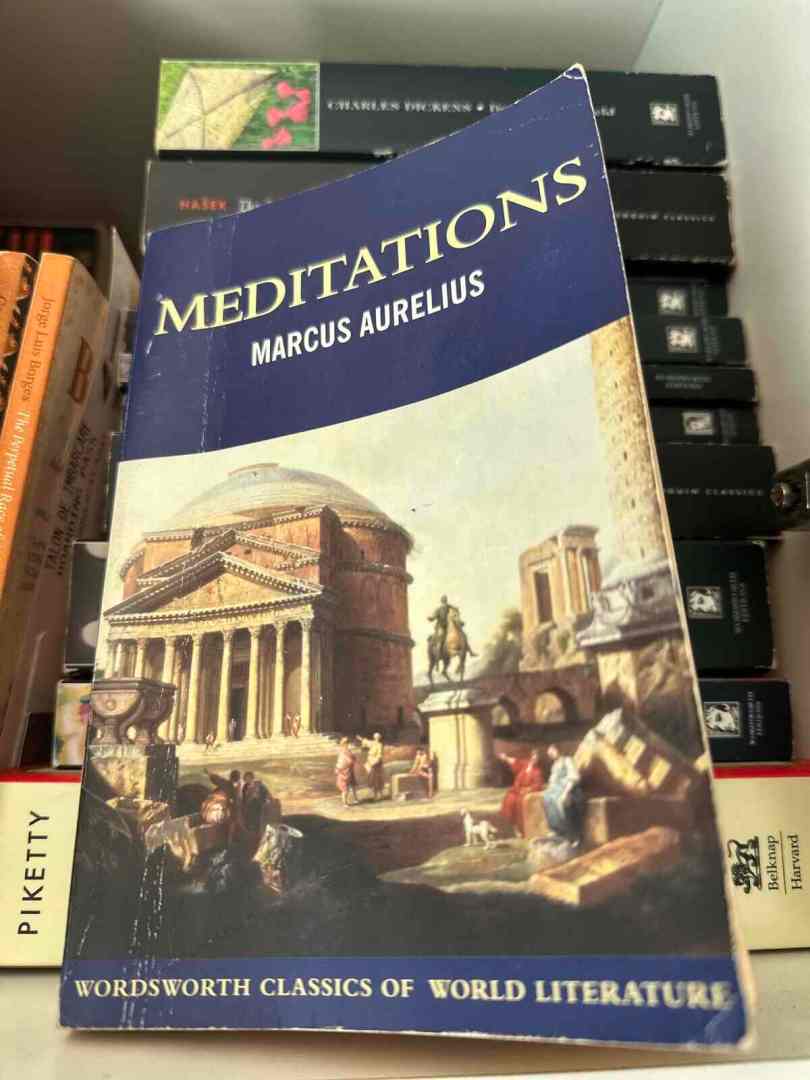
In Meditations1 in general, but especially in Book 7, Marcus Aurelius keeps reminding us that, no matter who we are and no matter what we do, sooner or later, we will be forgotten. My favorite quote summarizing this is:
Close is the time when you will forget all things; and close, too, the time when all will forget you.
– Marcus Aurelius, Meditations
But when one reads this as a standalone quote, one can may come to various conflicting conclusions. So, let’s look at the other quotes and see what we understand from them.
How many whose praises were once widely sung are now consigned to oblivion; and how many who sang their praises are now departed and gone?
– Marcus Aurelius, Meditations
Everything material disappears very swiftly into the universal substance, and swiftly too every cause is reabsorbed into the universal reason, and very swiftly the memory of everything is buried in eternity.
– Marcus Aurelius, Meditations
On fame: Look at the minds and see what they are like, and the sort of things that they flee from and those that they pursue. And reflect, too, that just as sand dunes are always drifting over one another and concealing what came before, so in life also, what comes earlier is very swiftly hidden by all that piles up afterwards.
– Marcus Aurelius, Meditations
And in another place, he says, “How many a Chrysippus, how many a Socrates, how many an Epictetus has time already engulfed.” And then, he also says things like, “In no time at all both you and the wrongdoer will be dead…”
So, what does it mean for the Stoic to remember that he’ll be forgotten? It is to be aware of his mortality and embrace it.
Some may say here, of course, that every adult on the planet knows that he’s eventually going to die. Yes, that is true; however, even with that knowledge, most live as if they’re never going to die. That is what separates the Stoic from the rest. As Ernest Becker puts it in The Denial of Death,2 “Everything that man does in his symbolic world is an attempt to deny and overcome his grotesque fate.” Conversely, we have the Stoic who wakes up every day and takes the pill that reminds him of his impermanence.
For the Stoic, freedom really begins when you stop desiring to be remembered, when you stop being afraid to be forgotten. That’s when you stop caring about the opinions of others and start living for yourself, doing good for its own sake.
To become a Stoic, one must first remember that he’ll be forgotten.
[1] Here I am again, revisiting Marcus Aurelius, reading Meditations. The last time I opened Meditations and shared quotes from it was years ago. But there’s something about this book that makes you want to pick it up again (and again). No wonder interest in Stoicism has spiked in recent years. A book that was written 2,000 years ago that is packed with great advice and a philosophy that comes in handy in the 21st century. (Although, in a book I read recently — The Tragic Mind by Robert D. Kaplan — I came across a passage that said Stoicism is a philosophy suited for slaves. This is, of course, something to think about… but later.)
[2] Becker, Ernest. The Denial of Death. The Free Press, 1997.


