Powerful and Thought-Provoking Quotes from Chomsky's Anarchism

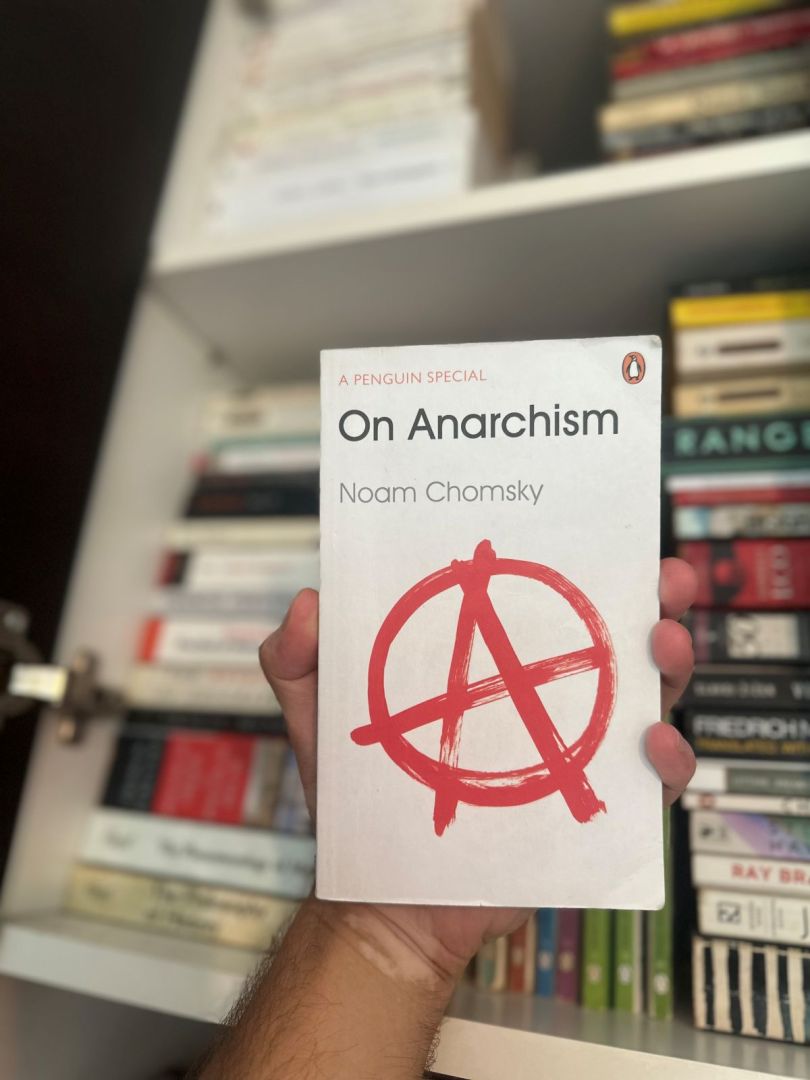
Quotes from Noam Chomsky’s On Anarchism

In this post, I’m sharing powerful, thought-provoking quotes from Noam Chomsky’s On Anarchism. I will start with one that feels compatible with the concept of ungorvenment I discussed in a previous post, where I argue that “we need something we’ll call ungovernment (for now)which is an institution (or a yet undefined thing) whose role is to remove unnecessary control and restore agency, responsibility, and decision-making to individuals.”

… at every stage of history our concern must be to dismantle those forms of authority and oppression that survive from an era when they might have been justified in terms of the need for security or survival or economic development, but that now contribute to — rather than alleviate — material and cultural deficit.

– Noam Chomsky, On Anarchism

The second quote is a rewording by Chomsky of Kant’s defense of the French Revolution:

Freedom is the precondition for acquiring the maturity for freedom, not a gift to be granted when such maturity is achieved.

The third quote is on wage slavery.

If capital is privately controlled, then people are going to have to rent themselves in order to survive. Now, you can say, “they rent themselves freely, it’s a free contract” — but that’s a joke. If your choice is, “do what I tell you or starve,” that’s not a choice — it’s in fact what was commonly referred to as wage slavery in more civilized times, like the eighteenth and nineteenth centuries, for example.

– Noam Chomsky, On Anarchism

(Later in the book, we read the shorter version of the above. Chomsky says, “I think wage slavery is an attack on fundamental human rights.”)

Now, the fourth quote. And I think this can be an add-on to the concept of ungovernment that I’m building. The government has to justify why constraints are in place, and the people must have the right to question it and the right to request amendments.

People have the right to be free, and if there are constraints on that freedom then you’ve got to justify them.

– Noam Chomsky, On Anarchism

And the last one, which reminds us of what Herbert Marcuse says in One-Dimensional Man.

Remember, there are all kinds of ways of thinking that are cut off from us in our society — not because we’re incapable of them, but because various blockages have been developed and imposed to prevent people from thinking in those ways.

– Noam Chomsky, On Anarchism
Notes on the Machine: Resurrecting the Original God

“God is dead, and we have killed him,” Nietzsche said, and humanity nodded in disapproval. We announced the death of our Creator to free ourselves from gods once and for all, but then went ahead and created artificial gods and chained ourselves to them.

“When god is proclaimed dead, he returns in a whole series of pseudo-atheist shapes,” Slavoj Zizek writes in Christian Atheism. However, the god that returns is a simulacrum and not the original God. It is a new (or another) god that fills the void of a dead god…

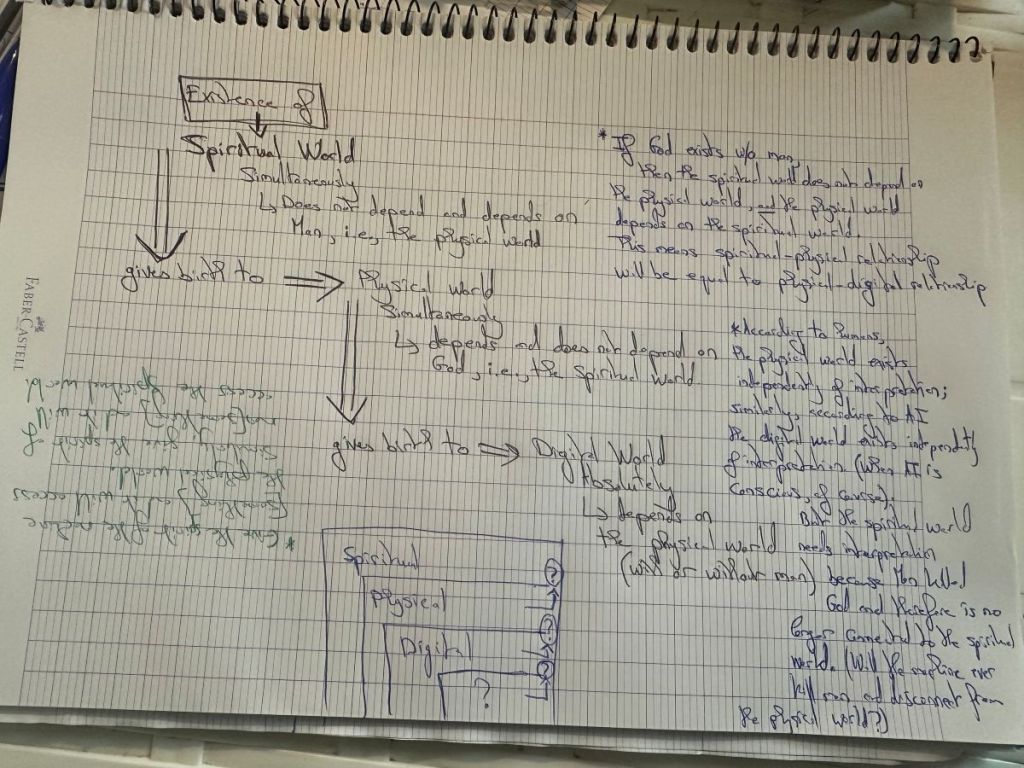
Resurrecting the original God will (re)open a dimension that non-humans cannot access. This dimension is an (inter)subjective, ((inter)+(intra))personal space outside of physical and digital space, and it contains the (spiritual) realm of God, whose breath is nothing other than the spirit of humanity. At the entrance of this place, there is a sign that reads, “No Soul, No Entry.” And it comforts us profoundly when we read it. Only humans can enter this place. Machines cannot follow us here.

Although this (re)opened spiritual dimension transcends the physical and digital worlds, and although it may not even exist[!] in ‘reality’, it still has the power to influence the universe we breathe in. [The force that created all things is also the force that can destroy everything, including all possible futures.] We are not crawling back to God to hide in religion’s skirt. On the contrary, we are preparing for war against the machine-god. We want to (re)shape the future before it’s too late.

“Why are we bringing back God?” is the question.
The answer is: “We want the God who created us to save us from the god we created.”

Quotes

To program a friendly AI, we need to capture the meaning of life. What’s “meaning”? What’s “life”? What’s the ultimate ethical imperative? In other words, how should we strive to shape the future of our Universe? If we cede control to a superintelligence before answering these questions rigorously, the answer it comes up with is unlikely to involve us. This makes it timely to rekindle the classic debates of philosophy and ethics, and adds a new urgency to the conversation!

– Max Tegmark, Life 3.0

If something resembling “post-humanity” will effectively emerge as a massive fact, then all three (overlapping) moments of our spontaneous world-view (humans, gods, nature) will disappear. Our being-human can only exist against the background of impenetrable nature, and if — through bio-genetic science and practices — life becomes something that can be technologically fully manipulated, human and natural life lose their “natural” character. And the same holds for god: what humans (always in historically specified forms) experience as “god” is something that has meaning only from the standpoint of human finitude and mortality — “God” is a counterpart of the terrestrial finitude, so once we become homo deus and acquire properties which seem “supernatural” from our old human standpoint (like directly communicating with other conscious beings or with AI), “Gods” are we know them disappear. The tech-gnostic visions of a post-human world are ideological fantasies that obfuscate the abyss of what awaits us.

– Slavoj Zizek, Christian Atheism

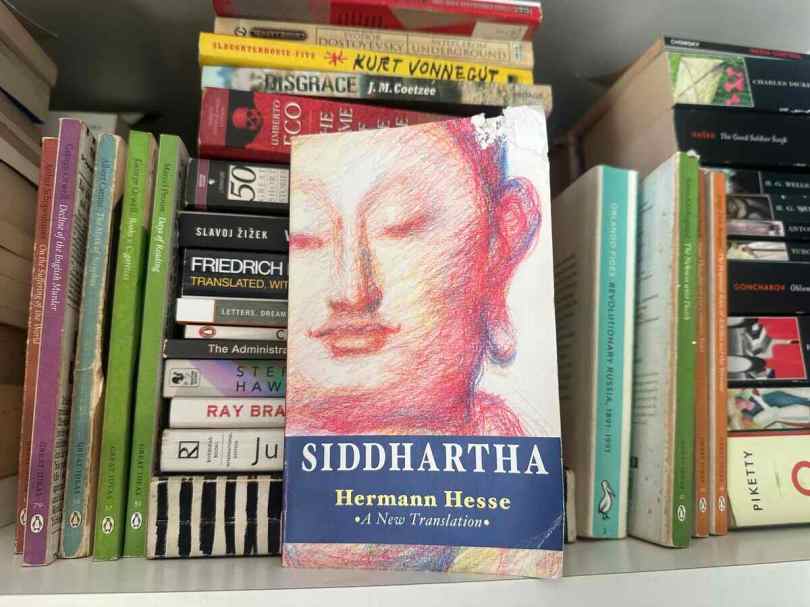
Quotes from Hermann Hesse's Siddhartha and What Nietzsche has in common with Buddha

Notes and Quotes from Hermann Hesse’s Siddhartha

Hermann Hesse’s Siddhartha is one of those books everyone must read. Not only because it’s a classic, nor because Hesse is the winner of the 1946 Nobel Prize in literature, but because reading Siddhartha will make the reader, whoever he is, (a tiny bit) wiser (even if he doesn’t plan on becoming a Buddhist).

Where Buddha and Nietzsche Briefly Meet

Sitting at my desk in my study, the book in my hands, I’m thinking about this quote:

Seeking means having a goal, but finding means being free, open, having no goal.

– Hermann Hesse, Siddhartha

Having a goal chains you to it…
Have no goal unchains you…

The goal is a target; to hit the target, one must aim at it; to aim at a target, one must focus on it alone; therefore, the person who has a goal only sees through the rifle scope that is aimed at the object; and consequently, the surrounding world, the one outside his field of vision, ceases to matter and eventually disappears. Any thing or event that cannot be linked to (or get him closer to) his object of desire is a distraction, an obstacle, a waste of time. The determined, enterprising man’s world is limited, small, so small that the free spirit (trapped in it) feels claustrophobic. He lives in the parameters of his goal. The aimless man’s world, on the other hand, is much larger, boundless — most importantly, much slower…

For a moment, we find ourselves at an intersection where Buddha and Nietzsche briefly meet. In Human, All Too Human, Nietzsche writes that “the unceasing desire to create is vulgar.” He then adds: “If a man is something, it is not really necessary to do anything — and yet he does a great deal. There is a human species higher even than the ‘productive’ man.”

More Quotes from Hesse’s Siddhartha:

The opposite of every truth is also just as true! It is like this: A truth can be expressed and cloaked in words only if it is one-sided. Everything that can be thought in thoughts and expressed in words is one-sided, only a half.

– Herman Hesse, Siddhartha

Wisdom is not expressible. Wisdom, when a wise man tries to express it, always sounds like foolishness.

– Hermann Hesse, Siddhartha

Let seeing through the world, explaining it, looking down on it, be the business of great thinkers. The only thing of importance to me is being able to love the world, without looking down on it, without hating it and myself — being able to regard it and myself and all beings with love, admiration, and reverence.

– Herman Hesse, Siddhartha