Notes on Plato’s Laws: Divine Goods and Human Goods

In Plato’s Laws, we read that the object of laws is to make men “who use them happy, and they confer every sort of good.”

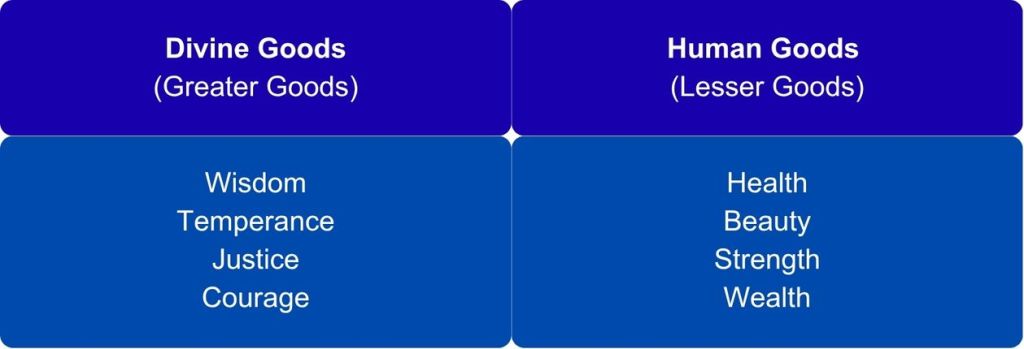
“Goods are of two kinds,” Plato says. The human goods (or lesser goods) include health, beauty, strength, and wealth. The divine goods include wisdom, temperance, justice, and courage. And of them all, wisdom is the most divine.

Laws that focus on the divine goods automatically benefit and improve the human goods; however, laws that try to optimize the human goods end up depriving citizens of both.
Is it not the same when it comes to personal development? When one aims to become better, what must one go after? In today’s world, it is the norm to go after what Plato calls the lesser goods.

When someone decides to change their life, the first thing they do is change their diet, eat better, and go to the gym. This makes them healthier and stronger. Then, they change their wardrobe, the way they dress (and wear their makeup), so that they look better and become more attractive. Then, they start a side hustle or build their own business in order to become financially independent.

All of these things are good things, of course, but those who focus on them miss the point. They forget why they are after them. Or worse, they have not thought deeply about why they want these things so badly.

Deep down, we all want to live a meaningful, fulfilling life, and for that, we need to focus on acquiring the divine goods rather than the human goods. Because, as Plato says, “The state which attains the greater, at the same time acquires the less, or, not having the greater, has neither.”


References:

Plato. Laws. Translated by Benjamin Jowett. Apple Books, 2008.

Anger Management

If you’ve ever been angry, and I’m sure you have, then you know exactly what Homer means when, in Iliad, he writes that, even to the wisest men, anger is sweeter than honey.

Have you observed that, when two people start shouting at one another, neither of them wants to stop? They are both impelled to escalate the argument and release more anger. Most of the time, both parties are even aware that they are crossing their limits with what they are saying, but they cannot stop themselves. This is why most arguments end in a completely different arena than the one they started in. And usually, the new arena is much more serious than the initial one.

To never be upset about anything, of course, is impossible. We’d be callow if we don’t acknowledge that. What matters, then, is not how one keeps anger at bay… but how one handles the emotion.

In Psycho-Cybernetics 365, Matt Furey tells us about the Zen monk who was asked if he ever gets angry. The monk’s answer to the question was: “Every day. But what used to make me angry for a few days or hours is now something I catch and neutralize within minutes.” The problem isn’t the number of times you get angry per day. The problem is you allowing the anger to extend and overstay its welcome.

Aristotle said something like, “It is easy to be angry, but it’s very hard to be angry with the right person, at the right time, and for the right reason.”

Like everything else, anger management takes practice.

Notes on the Machine: No Jobs in the Future

You’re worried that, sooner or later, AI will replace you and you will be unemployed (and eventually even become unemployable). How will you be able to provide for your family, then? What will you do when they tell you that you will never find a job again because all jobs have been handed over to machines? You don’t know.

Sometimes, you allow your mind to drift and visit the future, where humans are not required to produce anything anymore because everything is produced by the Great Machine. You find it easy to imagine a world without work, where artificial intelligence (with its fifty trillion tentacles) does all the work. But somehow you find it very hard to imagine a role humans can play in that world. No, you cannot think up one important role they can play.

Your mind hovers over the cities of the future like an all-seeing invisible eye looking for humans. In some cities, there are no humans at all. In other cities, humans are there, but their roles are obsolete, and they just hang about idly waiting for something to happen to them. Yet, here and there, there is a city or two in which you detect higher human activity. But what are they all doing? Eating, drinking, and playing all the time. Some of them are making handmade bracelets while others are painting. A lot of them are sunbathing. A few of them are reading books. But what are they really doing? They seem to be waiting… waiting for you to give them ideas.

Now, you think: When this happens, I may not need to worry about providing for my family because, very likely, we’d have entered a post-scarcity world, where there’s absolutely everything abundantly for absolutely everyone. (That is the best case scenario, after all, isn’t it?)

“A job is not simply a source of income but of meaning, purpose, and direction in life as well,” Daniel Susskind writes in A World Without Work. What he says may not be undoubtedly true, but that is how you (and everybody else) have been programmed. Susskind writes, “In a world with less work, we will face a problem that has little to do with economics at all: how to find meaning in life when a major source of it disappears.” And then he quotes Keynes who says, “There is no country and no people, I think, who can look forward to the age of leisure and abundance without a dread. For we have been trained too long to strive and not to enjoy.”

When there’s no more work, what will you do? Who will you become?

Something tells you that gaming will replace work for most people. These individuals will plug themselves into an open-world game where simulations of work keep everyone busy…

And then, there will be others who prefer leisure, who will eat, sleep, and consume slop, and slowly drown in the infinite ocean of simulacra and simulation…

But nothing is inevitable yet. Not yet.