Jean-Jacques Rousseau quotes from Discourse on the Origin of Inequality

Quotes from Jean-Jacques Rousseau’s Discourse on the Origin of Inequality

Here are five quotes from Jean-Jacques Rousseau’s Discourse on the Origin of Inequality:

It is by the activity of our passions, that our reason improves: we covet knowledge merely because we covet enjoyment, and it is impossible to conceive why a man exempt from fears and desires should take the trouble to reason.

– Jean-Jacques Rousseau, Discourse on the Origin of Inequality

The first man, who, after enclosing a piece of ground, took it into his head to say, “This is mine,” and found people simple enough to believe him, was the true founder of civil society.

– Jean-Jacques Rousseau, Discourse on the Origin of Inequality

With the poet, it is gold and silver, but with the philosopher it is iron and corn, which have civilized men, and ruined mankind.

– Jean-Jacques Rousseau, Discourse on the Origin of Inequality

I dare almost affirm that a state of reflection is a state against nature, and that the man who meditates is a depraved animal.

– Jean-Jacques Rousseau, Discourse on the Origin of Inequality

There is scarce any inequality among men in a state of nature, all that which we now behold owes its force and its growth to the development of our faculties and the improvement of our understanding, and at last becomes permanent and lawful by the establishment of property and laws.

– Jean-Jacques Rousseau, Discourse on the Origin of Inequality
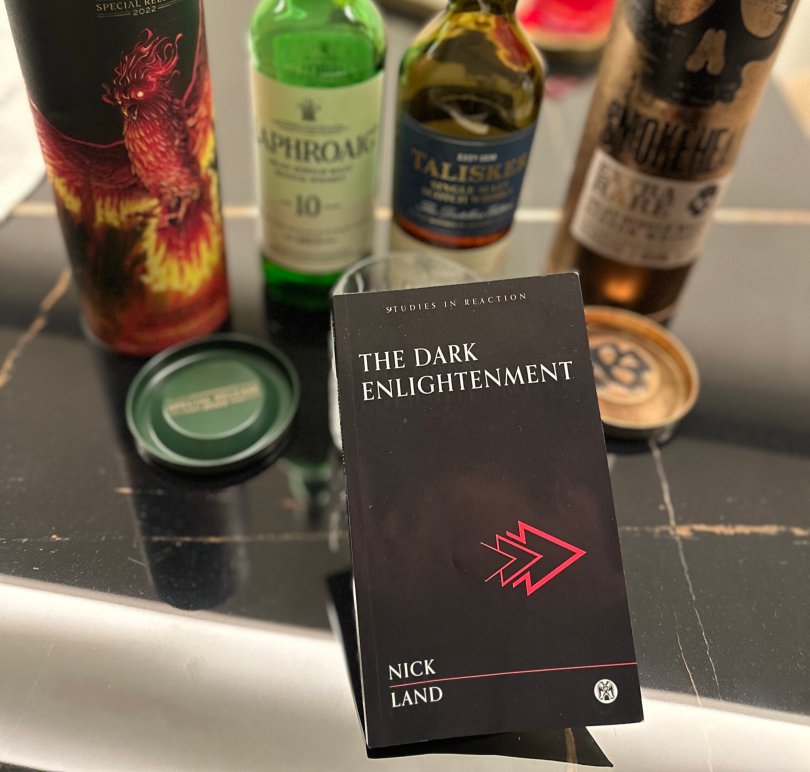
Book Review and Quotes from Nick Land's The Dark Enlightenment

Five Quotes from Nick Land’s The Dark Enlightenment

When I read Nick Land’s The Dark Enlightenment for the first time, I was not impressed by it at all. In fact, I was so disappointed that I commented on it on social media. I wrote, “I expected this book to be more than what it turned out to be. I was expecting the Nietzsche of the 21st century; I got a Hobbesian net surfer instead. Nick Land’s The Dark Enlightenment is the tea time chatter of a person you really don’t want to hang out with. Thankfully, the book is less than 100 pages. The only purpose this book can really serve is as a light commentary on Menius Moldbug’s (Curtis Yarvin’s) blog posts.”

That’s what I said then. So, if it’s so bad, why am I reading it again? Well… There is something so right about it, you see, but I don’t know what it is. (Of course, I do not agree and don’t have to agree with his politics to admire his texts, even if it’s a political text.) The Dark Enlightenment just has this magnetic power that pulls you, makes you want to chew the cud, and — what?

Quote from The Dark Enlightenment

Since winning elections is overwhelmingly a matter of vote buying, and society’s informational organs (education and media) are no more resistant to bribery than the electorate, a thrifty politician is simply an incompetent politician, and the democratic variant of Darwinism quickly eliminates such misfits from the gene pool.

– Nick Land, The Dark Enlightenment

Anarcho-capitalist utopias can never condense out of science fiction, divided powers flow back together like a shattered Terminator, and constitutions have exactly as much real authority as a sovereign interpretative power allows them to have.

– Nick Land, The Dark Enlightenment

Democracy consumes progress.

– Nick Land, The Dark Enlightenment

The left thrives on dialectics, the right perishes through them.

– Nick Land, The Dark Enlightenment

When only tolerance is tolerable, and everyone (who matters) accepts this manifestly nonsensical formula as not only rationally intelligible, but as the universally-affirmed principle of modern democratic faith, nothing except politics remains.

– Nick Land, The Dark Enlightenment

Quotes from Niccolo Machiavelli’s The Prince

How important is Niccolo Machiavelli’s The Prince? I’d say that it’s not so important anymore. Anyone who’s half-aware of what’s going on in the world would find that Machiavelli is stating the obvious. In today’s world, the Machiavellian nature of politics is a given. We do not need to discover it; we know it from the start. There isn’t a man out there who believes politicians are honest folks just doing their job. They lie to us every day, and we know, but we believe them anyway. It’s how the world works.

So, in that respect, we can say that the contemporary man understands Machiavelli without even reading his work. In the past, people may have believed that there were honest princes or politicians, so The Prince could have shocked the readers of the past who could not even have guessed we’d have something called the internet one day. (In fact, 16th, 17th, and 18th-century readers were so disturbed that they believed Machiavelli was inspired by the devil.) In the 21st century, however, The Prince has become literature for the necrophiles. It is still readable, of course. But more than half a millennium has passed since Machiavelli’s death, and if one’s goal is to conquer the world, he’ll find books like Robert Greene’s 48 Laws of Power much more useful to him than merely The Prince.

Nonetheless, since I have revisited the book anyway, I’ll save some of the sentences I have underlined here and make a blog post out of it. Enjoy the quotes!


Quotes from Machiavelli’s The Prince

“It is in the nature of things that as soon as a powerful foreigner enters a province, all the weaker powers in it will become his allies through envy of those who have been ruling over them.”

“A prince must have no other objective, no other thought, nor take up any profession but that of war.”

“He who causes another to become powerful ruins himself.”

“A prince, therefore, should always seek advice, but only when he, not someone else, chooses.”

“A prince should avoid joining forces with someone more powerful than himself for the purpose of attacking another unless necessity compels him to do so.”

“A wise prince must provide in such a way that, in whatever circumstances, the citizens will always be in need of him and of his government. Then they will always be loyal to him.”