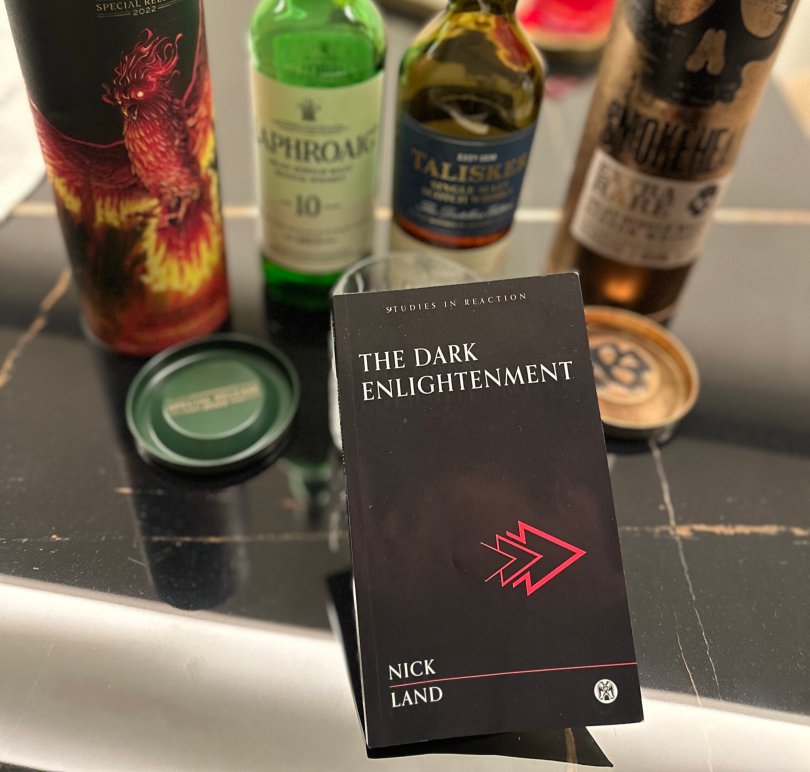
Book Review and Quotes from Nick Land's The Dark Enlightenment

Five Quotes from Nick Land’s The Dark Enlightenment

When I read Nick Land’s The Dark Enlightenment for the first time, I was not impressed by it at all. In fact, I was so disappointed that I commented on it on social media. I wrote, “I expected this book to be more than what it turned out to be. I was expecting the Nietzsche of the 21st century; I got a Hobbesian net surfer instead. Nick Land’s The Dark Enlightenment is the tea time chatter of a person you really don’t want to hang out with. Thankfully, the book is less than 100 pages. The only purpose this book can really serve is as a light commentary on Menius Moldbug’s (Curtis Yarvin’s) blog posts.”

That’s what I said then. So, if it’s so bad, why am I reading it again? Well… There is something so right about it, you see, but I don’t know what it is. (Of course, I do not agree and don’t have to agree with his politics to admire his texts, even if it’s a political text.) The Dark Enlightenment just has this magnetic power that pulls you, makes you want to chew the cud, and — what?

Quote from The Dark Enlightenment

Since winning elections is overwhelmingly a matter of vote buying, and society’s informational organs (education and media) are no more resistant to bribery than the electorate, a thrifty politician is simply an incompetent politician, and the democratic variant of Darwinism quickly eliminates such misfits from the gene pool.

– Nick Land, The Dark Enlightenment

Anarcho-capitalist utopias can never condense out of science fiction, divided powers flow back together like a shattered Terminator, and constitutions have exactly as much real authority as a sovereign interpretative power allows them to have.

– Nick Land, The Dark Enlightenment

Democracy consumes progress.

– Nick Land, The Dark Enlightenment

The left thrives on dialectics, the right perishes through them.

– Nick Land, The Dark Enlightenment

When only tolerance is tolerable, and everyone (who matters) accepts this manifestly nonsensical formula as not only rationally intelligible, but as the universally-affirmed principle of modern democratic faith, nothing except politics remains.

– Nick Land, The Dark Enlightenment

Quotes from Niccolo Machiavelli’s The Prince

How important is Niccolo Machiavelli’s The Prince? I’d say that it’s not so important anymore. Anyone who’s half-aware of what’s going on in the world would find that Machiavelli is stating the obvious. In today’s world, the Machiavellian nature of politics is a given. We do not need to discover it; we know it from the start. There isn’t a man out there who believes politicians are honest folks just doing their job. They lie to us every day, and we know, but we believe them anyway. It’s how the world works.

So, in that respect, we can say that the contemporary man understands Machiavelli without even reading his work. In the past, people may have believed that there were honest princes or politicians, so The Prince could have shocked the readers of the past who could not even have guessed we’d have something called the internet one day. (In fact, 16th, 17th, and 18th-century readers were so disturbed that they believed Machiavelli was inspired by the devil.) In the 21st century, however, The Prince has become literature for the necrophiles. It is still readable, of course. But more than half a millennium has passed since Machiavelli’s death, and if one’s goal is to conquer the world, he’ll find books like Robert Greene’s 48 Laws of Power much more useful to him than merely The Prince.

Nonetheless, since I have revisited the book anyway, I’ll save some of the sentences I have underlined here and make a blog post out of it. Enjoy the quotes!


Quotes from Machiavelli’s The Prince

“It is in the nature of things that as soon as a powerful foreigner enters a province, all the weaker powers in it will become his allies through envy of those who have been ruling over them.”

“A prince must have no other objective, no other thought, nor take up any profession but that of war.”

“He who causes another to become powerful ruins himself.”

“A prince, therefore, should always seek advice, but only when he, not someone else, chooses.”

“A prince should avoid joining forces with someone more powerful than himself for the purpose of attacking another unless necessity compels him to do so.”

“A wise prince must provide in such a way that, in whatever circumstances, the citizens will always be in need of him and of his government. Then they will always be loyal to him.”

The Wretched of the Earth by Franz Fanon Book Review

Personal Notes: Frantz Fanon’s The Wretched of the Earth

  • In the opening of The Wretched of the Earth, Frantz Fanon makes sure that we understand that “decolonization is always a violent event.” To liberate himself, the oppressed man can only succeed by resorting to every means, including violence.
  • Does the colonist “know” the colonized subject? Yes, because the colonist is the one who created (and is always in the process of creating) the colonized subject.
  • Decolonization is the creation of new men who, up until their liberation, were defined by the colonist and were treated as sub-humans. The creation of “new men” is a central aspect of decolonization. To finally be free, the oppressed man must give birth to himself; to liberate himself, he must redefine himself. As long as he is defined by the Other, he is still colonized. A “new man” is a must. If you want to be more like Europe, why fight for your independence from them? Fanon writes, “Humanity expects other things from us than this grotesque and generally obscene emulation.” He wants the Third World to start a new history of man. Accordingly, he concludes the book with the following: “For Europe, for ourselves and for humanity, comrades, we must make a new start, develop a new way of thinking, and endeavor to create a new man.”
  • The colonist will always be afraid of the colonized subject because he simply knows that, when the day comes, he must pay for the suffering he caused. The “dignity” he took away from the colonized subject is a debt that must be paid back in full. In the eyes of the man he colonized, he sees the promise of violence — he sees his demise.
  • The colonized subjects know that they are not, as they are often portrayed, violent animals, but they also know that violence is the only language colonial powers understand. “The colonized man liberates himself in and through violence.”
  • The oppressor (the colonist, or the bourgeois, or the ruling class) always appears to be more civilized. They present themselves as peaceful, non-violent beings. Educated and cultured, they have their savoir-vivre and their etiquettes. But these things are nothing but curtains and masks. They show their true selves as soon as the colonized man’s fingers roll info fists. Even those who remain “neutral” and “objective” are oppressors. As Fanon puts it, “For the colonized subject, objectivity is always directed against him.”
  • “The colonial world is a compartmentalized world.” There’s the oppressor’s part of town, and there’s the part of town that belongs to the oppressed. These “parts,” however, don’t necessarily have to be geographical. The oppressor and the oppressed may live on the same street or work in the same building. But even when they occasionally hug and dance like inseparable friends or lovers, there’s still a line — visible or invisible — that separates them. The colonists feel protected by the law and the police. The colonized subjects don’t.
  • When they rape the wife or kill the child of the colonized subject, nothing happens. When the oppressed man is tortured, he does not complain. He knows that the authorities of oppression will not punish what imitates or reinforces them.
  • Two things that keep order in the colonized world: force and education. The boot and the book. By force we mean the police or the army. By education we mean the teaching of values that “instill in the exploited a mood of submission and inhibition which considerably eases the task of the agents of law and order.”
  • “The colonized man is an envious man.” The oppressed man dreams of taking the place of the oppressor. His dreams are “muscular dreams, dreams of action, dreams of aggressive vitality.”
  • There are no good colonists.
  • “The apotheosis of independence becomes the curse of independence.”