Side Notes on Paul Klee’s In the Style of Kairouan

Looking at a 1914 watercolor and pencil painting by Paul Klee. It’s called In the Style of Kairouan, and it is considered Klee’s first abstract work.

Something about the work makes me feel like I’m reading someone’s diary — in this case, Klee’s diary. It is a profoundly personal journal entry written in a language that only sounds familiar but isn’t. I cannot see this painting from the other side. I cannot see it through Klee’s eyes, using his mind to decrypt the work, and this keeps me from understanding the thing in itself but it’s fine because it is an opportunity to drift freely and enjoy a moment of meaning creation. At first, I explore the surface of the work intensely. I actively form interpretations in my mind, and then I let go and get lost in it like a log in the middle of the sea.

There is a simplicity in the painting that almost makes me uncomfortable. Rectangles/quadrilaterals of different colors and sizes fill the space. There’s no room to breathe. Then, unpretentious circles come to turn the collage of rectangles into… art.

Most of the rectangles/quadrilaterals stand vertically, except a few. The circles live inside the horizontal ones, but not all horizontal rectangles/quadrilaterals have circles in them. The left side of the painting is conquered by the spirit of red; the right side by the spirit of green.

Could it be that Klee’s unconscious did most of the work?

I’d like to believe it’s a moment of boredom that served as the fertile soil for this piece.

Although there’s nothing to see here, there’s a lot to stay for.
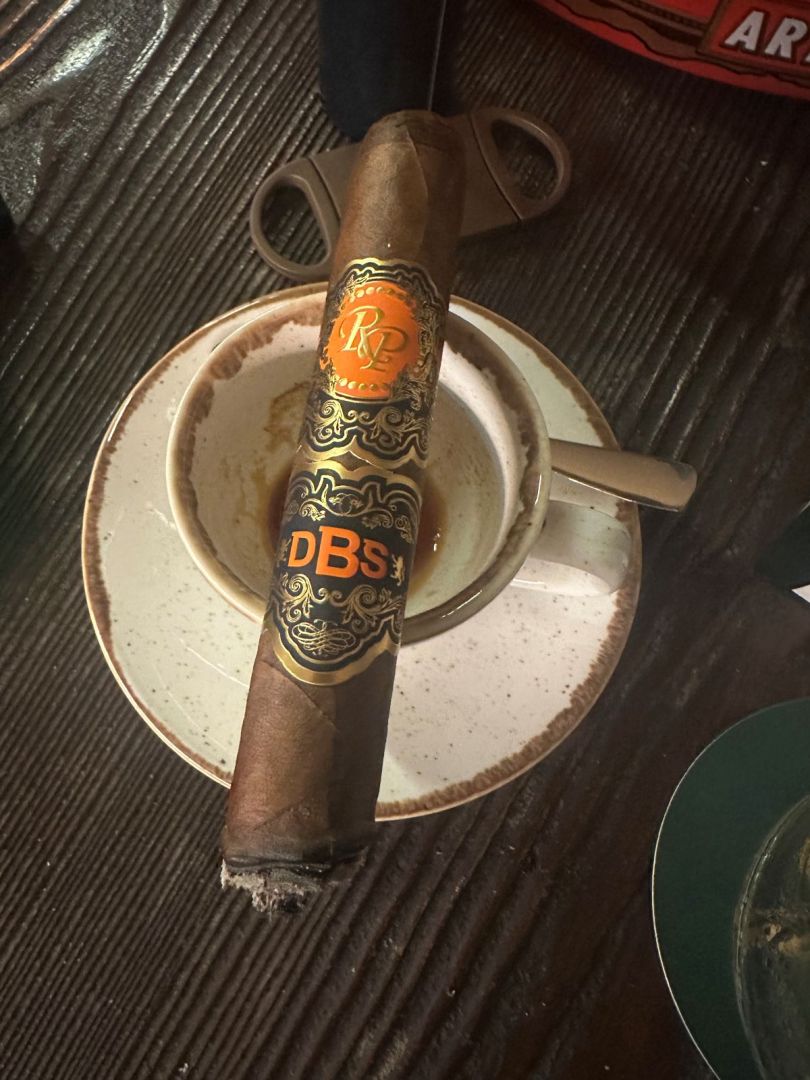
Chris Khatsch at Mareva Beirut Lebanon Reviewing the Rocky Patel DBS Cigar

Have a Cigar: Rocky Patel DBS Toro

Name: Rocky Patel DBS Toro
Country: Nicaragua
Shape: Parejo
Size: Toro (6 1/2 inches x 52)
Strength: Medium-to-Full

The Rocky Patel DBS Toro is a good-looking cigar. As soon as your gaze lands on it, you are invited to pick it up and, even if you’re not going to choose it, you at least hold it for a moment and imagine yourself smoking it.

This time, the owner of the cigar lounge suggested I try it, and since I know that he knows what I like, and since I enjoy Rocky Patel cigars already, I went ahead with it.

I paired it with espresso and sparkling water.

The Rocky Patel DBS Toro burned slowly and (somewhat) evenly. It had an excellent draw and produced a generous amount of smoke. I got notes of wood, cocoa powder, earth, and pink peppercorn.

The amount of time it took me to smoke it was somewhere between 90 minutes and two hours.

When I smoke it next time, I think I’ll pair it with aged rum.

Influence as Capital

In Leo Tolstoy’s War and Peace, we read: “Influence in the world is a capital, which must be carefully guarded if it is not to disappear.”

The character who thinks so also thinks that “if he were to beg for all who begged him to do so, he would soon be unable to beg for himself.” That is why he rarely uses his influence. He prefers to save it for a rainy day.

Influence is a capital, but there is more than one way to use it. You can spend influence (like you spend money), and you can also invest it.

You can spend influence on favors, for instance. The more favors you ask from a person, the less influence you’ll have over him. Eventually, you’ll run out of influence, and you can no longer ask for favors. (The number of favors you can request depends on the “cost” of the favor and the number of influence “points” you have.)

Investing influence is a little different. It goes like this: The son of someone important is looking for a job, so you help him find work by using the influence you have in the company you work for. In this case, you did not spend your influence, you invested it. In the future, the son will be ready to return the favor, and the father will use a bigger influence for you to get something you want. (Note, however, that all investments come with risks. You may invest your influence but get nothing in return.)