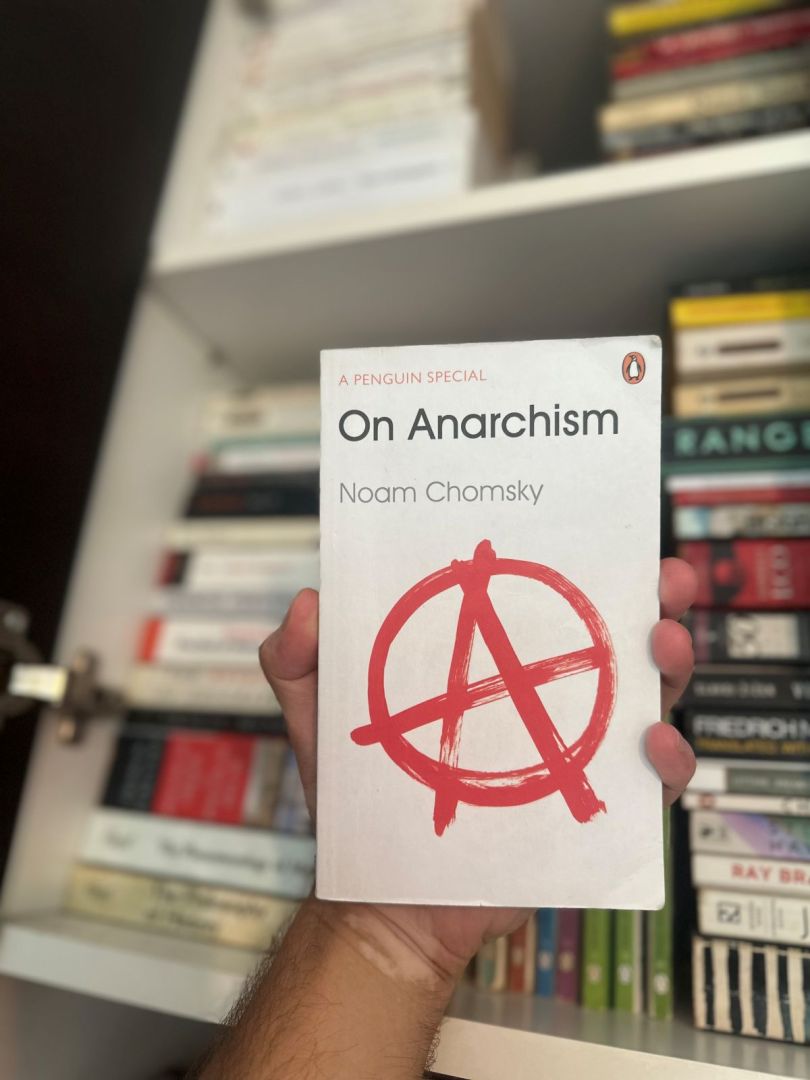
Powerful and Thought-Provoking Quotes from Chomsky's Anarchism

Quotes from Noam Chomsky’s On Anarchism

In this post, I’m sharing powerful, thought-provoking quotes from Noam Chomsky’s On Anarchism. I will start with one that feels compatible with the concept of ungorvenment I discussed in a previous post, where I argue that “we need something we’ll call ungovernment (for now)which is an institution (or a yet undefined thing) whose role is to remove unnecessary control and restore agency, responsibility, and decision-making to individuals.”

… at every stage of history our concern must be to dismantle those forms of authority and oppression that survive from an era when they might have been justified in terms of the need for security or survival or economic development, but that now contribute to — rather than alleviate — material and cultural deficit.

– Noam Chomsky, On Anarchism

The second quote is a rewording by Chomsky of Kant’s defense of the French Revolution:

Freedom is the precondition for acquiring the maturity for freedom, not a gift to be granted when such maturity is achieved.

The third quote is on wage slavery.

If capital is privately controlled, then people are going to have to rent themselves in order to survive. Now, you can say, “they rent themselves freely, it’s a free contract” — but that’s a joke. If your choice is, “do what I tell you or starve,” that’s not a choice — it’s in fact what was commonly referred to as wage slavery in more civilized times, like the eighteenth and nineteenth centuries, for example.

– Noam Chomsky, On Anarchism

(Later in the book, we read the shorter version of the above. Chomsky says, “I think wage slavery is an attack on fundamental human rights.”)

Now, the fourth quote. And I think this can be an add-on to the concept of ungovernment that I’m building. The government has to justify why constraints are in place, and the people must have the right to question it and the right to request amendments.

People have the right to be free, and if there are constraints on that freedom then you’ve got to justify them.

– Noam Chomsky, On Anarchism

And the last one, which reminds us of what Herbert Marcuse says in One-Dimensional Man.

Remember, there are all kinds of ways of thinking that are cut off from us in our society — not because we’re incapable of them, but because various blockages have been developed and imposed to prevent people from thinking in those ways.

– Noam Chomsky, On Anarchism

I’m an Assemblage

I’m an assemblage of
stereotypes, of
false beliefs, ideologies,
and memes.

Lines and lines of
code are carved
on the walls of
my mind.

The codes keep rewriting themselves,
but the traces of
the first lines of
code
never fully fade.

For a long time, my goal was
to rid myself of
everything that isn’t me
to see what remained.

The plan was to rebuild from
scratch, from
nothingness, or from
whatever remained when
everything that isn’t me was removed from
me.

I understand now
that,
when everything that isn’t me is removed,
what remains isn’t me.
What remains is traces,
the residues of what was.

Review of Walter Benjamin's The Work of Art in the Age of Mechanical Reproduction

Thoughts after Reading Walter Benjamin’s The Work of Art in the Age of Mechanical Reproduction

Two ways to experience art. — In Walter Benjamin’s The Work of Art in the Age of Mechanical Reproduction, we find that there are two ways to experience art: The way the “distracted mass” experiences art and the way a true appreciator experiences art. While the former absorbs art, the latter is absorbed by it. “This is at the bottom the same ancient lament that the masses seek distraction whereas art demands concentration from the spectator.” The masses expect one thing from a work of art — to be entertained by it. They want their art to be simple and straightforward (with only an illusion of depth and complexity). On the other hand, “a man who concentrates before a work of art is absorbed by it. He enters into this work of art…” He swims in it, gets lost in it, interacts with it. He even participates in the process of artistic creation without perturbing the work of art. (This takes place in the mind of the art appreciator, of course.)

Freedom of speech. — The following sentence can help us understand what really takes place on platforms like X (formerly Twitter), for example. The sentence is: “Fascism sees its salvation in giving these masses not their right, but instead a chance to express themselves.” On social media, everyone has an opinion; unfortunately, however, opinions only appear to matter when they really don’t. (I have yet to hear someone has “changed sides” after being persuaded on social media that he was wrong all this time supporting a certain politician or other. Is it not only propaganda that makes one really change sides?) What we need to remember is this: Freedom of speech doesn’t necessarily mean freedom of thought. To end this, here’s another quote from The Work of Art in the Age of Mechanical Reproduction: “The public is an examiner, but an absent-minded one.”