Notes on Plato’s Laws: Similarities Between Cleinias and Hobbes

In Plato’s Laws, the Athenian asks Cleinias (who represents Crete) why their law ordains that they should have “common meals and gymnastic exercises, and wear arms.” Cleinias says that “all these regulations have been made with a view to war.” The legislator (must have) believed that “all men are always at war with one another.” And “for what men in general term peace would be said by him to be only a name; in reality every city is in a natural state of war with every other, not indeed proclaimed by heralds, but everlasting.”

This answer reminds me of Thomas Hobbes, who, in Leviathan, writes:

There Is Alwayes Warre Of Every One Against Every One Hereby it is manifest, that during the time men live without a common Power to keep them all in awe, they are in that condition which is called Warre; and such a warre, as is of every man, against every man. For WARRE, consisteth not in Battell onely, or the act of fighting; but in a tract of time, wherein the Will to contend by Battell is sufficiently known: and therefore the notion of Time, is to be considered in the nature of Warre; as it is in the nature of Weather. For as the nature of Foule weather, lyeth not in a showre or two of rain; but in an inclination thereto of many dayes together: So the nature of War, consisteth not in actuall fighting; but in the known disposition thereto, during all the time there is no assurance to the contrary. All other time is PEACE.

Hobbes and Plato’s character Cleinias seem to agree that war exists naturally between people and that the state of war is the natural state even when there’s no fighting going on. It looks like the main thing they don’t align on is the definition of peace. For Cleinias, there isn’t real peace because the underlying condition is always war. So, peace is only a name. It is like a bedsheet covering a dirty mattress. For Hobbes, peace can exist when there’s a power that enforces it.


References:

Plato. Laws. Translated by Benjamin Jowett. Apple Books, 2008.

Hobbes, Thomas. Leviathan. Apple Books, 1679.
Notes on Plato’s Laws: Divine Goods and Human Goods

In Plato’s Laws, we read that the object of laws is to make men “who use them happy, and they confer every sort of good.”

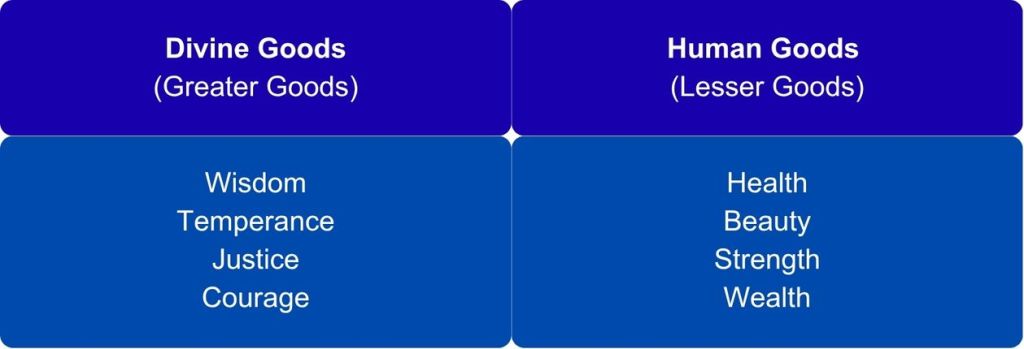
“Goods are of two kinds,” Plato says. The human goods (or lesser goods) include health, beauty, strength, and wealth. The divine goods include wisdom, temperance, justice, and courage. And of them all, wisdom is the most divine.

Laws that focus on the divine goods automatically benefit and improve the human goods; however, laws that try to optimize the human goods end up depriving citizens of both.

Is it not the same when it comes to personal development? When one aims to become better, what must one go after? In today’s world, it is the norm to go after what Plato calls the lesser goods.

When someone decides to change their life, the first thing they do is change their diet, eat better, and go to the gym. This makes them healthier and stronger. Then, they change their wardrobe, the way they dress (and wear their makeup), so that they look better and become more attractive. Then, they start a side hustle or build their own business in order to become financially independent.

All of these things are good things, of course, but those who focus on them miss the point. They forget why they are after them. Or worse, they have not thought deeply about why they want these things so badly.

Deep down, we all want to live a meaningful, fulfilling life, and for that, we need to focus on acquiring the divine goods rather than the human goods. Because, as Plato says, “The state which attains the greater, at the same time acquires the less, or, not having the greater, has neither.”


References:

Plato. Laws. Translated by Benjamin Jowett. Apple Books, 2008.

Review and Summary of Plato's Crito

A Reading of Plato’s Crito

A summary of Plato’s Crito

In one of Plato’s famous dialogues called Crito, Crito visits Socrates’ prison cell before daybreak to persuade him to escape. Socrates is in prison and is condemned to death, but when Crito tells him they could bribe people to bring him out of prison, he refuses. In fact, almost comically, even in prison, Socrates finds the time to use his signature “Socratic method” to decide whether he ought to escape or not. The answer, of course, turns out to be no because, even when one is wronged, one must not wrong the other in return. And the laws must be obeyed even when one is unjustly found guilty.

According to Socrates, the Law is like a father (or a master); the individual is like a child (or a slave). The individual belongs to the State and must do what the state orders him to do. Why? Because, from the day he is born, the individual is nurtured and educated by the State, protected by the State, given his rights by the State, etc. And if he does like what he is given, he can always pack his stuff and leave. (Where to? That’s not the State’s problem.) By staying in the State, the individual enters “into an implied contract that he will do as we [the State] command him.”

This is, in short, why Socrates chooses not to escape and, therefore, die.

Socrates, Jesus, and the opinions of others

Reading Crito now, on a cool Wednesday morning in September, I am reminded of that story in the Bible in which Peter draws his sword and cuts off the high priest’s servant’s ear who, among others, had come to the Garden of Gethsemane to arrest Jesus. “Put your sword into the sheath,” Jesus says to Peter. “Shall I not drink the cup which My Father has given Me?” (John 18:11) We see here that, like Socrates, Jesus also chooses not to escape. The cup which His Father has given Him is His hemlock.

Moreover, Crito is not (only) Peter. He is also an inverted Judas. Judas betrays Jesus for 30 pieces of silver, but Crito is ready to do the opposite for Socrates. “But, oh! my beloved Socrates, let me entreat you once more to take my advice and escape,” Crito says. “For if you die I shall not only lose a friend who can never be replaced, but there is another evil: people who do not know you and me will believe that I might have saved you if I had been willing to give money, but that I did not care.”

When Socrates hears these words, he says that one shouldn’t care about the opinion of the many. Crito disagrees because the opinion of the many has the power to ruin a man’s life. (Remember when Pilate offered to release Jesus, but the crowd persisted, demanding his crucifixion?) Yet Socrates manages to show Crito that the opinions of the unwise don’t matter. Only the opinions of the wise matter. And if there’s only one wise man among many, it’s only his opinion that matters.

In this sense, neither Socrates nor Jesus cared about the opinions of the masses. We can even say that they died because they didn’t care about their opinions.

From the POV of authorities (and the masses), they may have been lawbreakers; from the POV of their followers, however, they were either law-abiding citizens or “fulfillers” of the law. Most importantly, they themselves knew they were doing the right thing.

What can we learn from this?

Socrates did what Bukowski once said, “Find what you love and let it kill you.” He died defending what killed him…


References

Plato. The Trial and Death of Socrates: Four Dialogues. Translated by Benjamin Jowett. Dover Publications, 1992.