Notes on the Machine: Resurrecting the Original God

“God is dead, and we have killed him,” Nietzsche said, and humanity nodded in disapproval. We announced the death of our Creator to free ourselves from gods once and for all, but then went ahead and created artificial gods and chained ourselves to them.

“When god is proclaimed dead, he returns in a whole series of pseudo-atheist shapes,” Slavoj Zizek writes in Christian Atheism. However, the god that returns is a simulacrum and not the original God. It is a new (or another) god that fills the void of a dead god…

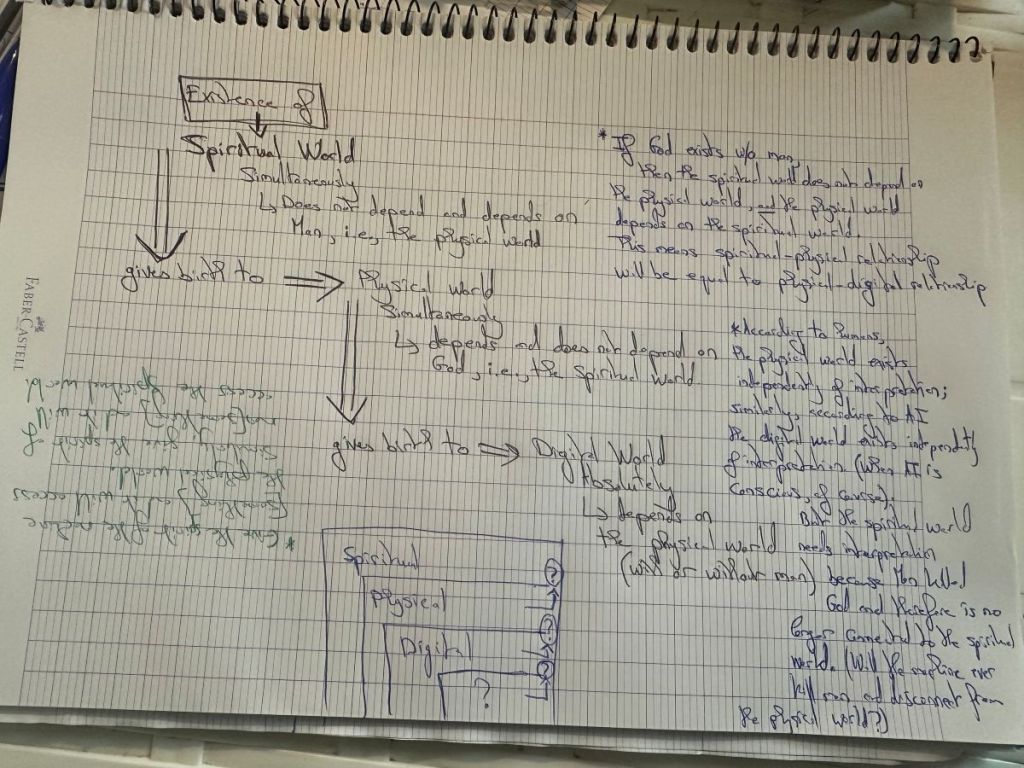
Resurrecting the original God will (re)open a dimension that non-humans cannot access. This dimension is an (inter)subjective, ((inter)+(intra))personal space outside of physical and digital space, and it contains the (spiritual) realm of God, whose breath is nothing other than the spirit of humanity. At the entrance of this place, there is a sign that reads, “No Soul, No Entry.” And it comforts us profoundly when we read it. Only humans can enter this place. Machines cannot follow us here.

Although this (re)opened spiritual dimension transcends the physical and digital worlds, and although it may not even exist[!] in ‘reality’, it still has the power to influence the universe we breathe in. [The force that created all things is also the force that can destroy everything, including all possible futures.] We are not crawling back to God to hide in religion’s skirt. On the contrary, we are preparing for war against the machine-god. We want to (re)shape the future before it’s too late.

“Why are we bringing back God?” is the question.
The answer is: “We want the God who created us to save us from the god we created.”
Quotes

To program a friendly AI, we need to capture the meaning of life. What’s “meaning”? What’s “life”? What’s the ultimate ethical imperative? In other words, how should we strive to shape the future of our Universe? If we cede control to a superintelligence before answering these questions rigorously, the answer it comes up with is unlikely to involve us. This makes it timely to rekindle the classic debates of philosophy and ethics, and adds a new urgency to the conversation!

– Max Tegmark, Life 3.0

If something resembling “post-humanity” will effectively emerge as a massive fact, then all three (overlapping) moments of our spontaneous world-view (humans, gods, nature) will disappear. Our being-human can only exist against the background of impenetrable nature, and if — through bio-genetic science and practices — life becomes something that can be technologically fully manipulated, human and natural life lose their “natural” character. And the same holds for god: what humans (always in historically specified forms) experience as “god” is something that has meaning only from the standpoint of human finitude and mortality — “God” is a counterpart of the terrestrial finitude, so once we become homo deus and acquire properties which seem “supernatural” from our old human standpoint (like directly communicating with other conscious beings or with AI), “Gods” are we know them disappear. The tech-gnostic visions of a post-human world are ideological fantasies that obfuscate the abyss of what awaits us.

– Slavoj Zizek, Christian Atheism
Quotes from Hermann Hesse's Siddhartha and What Nietzsche has in common with Buddha

Notes and Quotes from Hermann Hesse’s Siddhartha

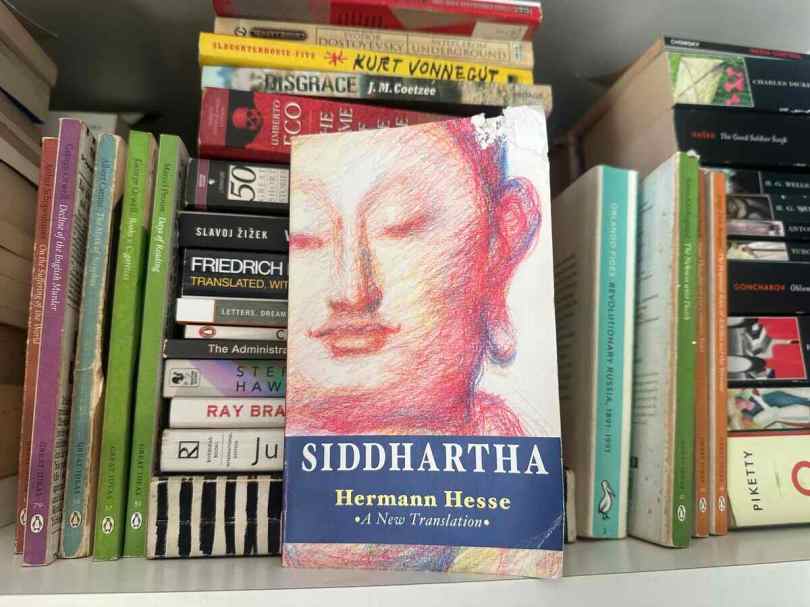
Hermann Hesse’s Siddhartha is one of those books everyone must read. Not only because it’s a classic, nor because Hesse is the winner of the 1946 Nobel Prize in literature, but because reading Siddhartha will make the reader, whoever he is, (a tiny bit) wiser (even if he doesn’t plan on becoming a Buddhist).

Where Buddha and Nietzsche Briefly Meet

Sitting at my desk in my study, the book in my hands, I’m thinking about this quote:

Seeking means having a goal, but finding means being free, open, having no goal.

– Hermann Hesse, Siddhartha

Having a goal chains you to it…
Have no goal unchains you…

The goal is a target; to hit the target, one must aim at it; to aim at a target, one must focus on it alone; therefore, the person who has a goal only sees through the rifle scope that is aimed at the object; and consequently, the surrounding world, the one outside his field of vision, ceases to matter and eventually disappears. Any thing or event that cannot be linked to (or get him closer to) his object of desire is a distraction, an obstacle, a waste of time. The determined, enterprising man’s world is limited, small, so small that the free spirit (trapped in it) feels claustrophobic. He lives in the parameters of his goal. The aimless man’s world, on the other hand, is much larger, boundless — most importantly, much slower…

For a moment, we find ourselves at an intersection where Buddha and Nietzsche briefly meet. In Human, All Too Human, Nietzsche writes that “the unceasing desire to create is vulgar.” He then adds: “If a man is something, it is not really necessary to do anything — and yet he does a great deal. There is a human species higher even than the ‘productive’ man.”

More Quotes from Hesse’s Siddhartha:

The opposite of every truth is also just as true! It is like this: A truth can be expressed and cloaked in words only if it is one-sided. Everything that can be thought in thoughts and expressed in words is one-sided, only a half.

– Herman Hesse, Siddhartha

Wisdom is not expressible. Wisdom, when a wise man tries to express it, always sounds like foolishness.

– Hermann Hesse, Siddhartha

Let seeing through the world, explaining it, looking down on it, be the business of great thinkers. The only thing of importance to me is being able to love the world, without looking down on it, without hating it and myself — being able to regard it and myself and all beings with love, admiration, and reverence.

– Herman Hesse, Siddhartha
Book Review and Quotes from Robert D Kaplan's The Tragic Mind: Fear, Fate, and the Burden of Power

Notes and Quotes from Robert D. Kaplan’s The Tragic Mind

The main message of Robert D. Kaplan’s The Tragic Mind is this: that political leaders and decision makers ought to think tragically. They need to be aware that, although there is good and evil in the world, politics is more often about a “battle of good against good.” They also need to be aware that, even though a decision must be made, political outcomes cannot always be win-win or even win-lose. Sometimes, all possible outcomes are lose-lose outcomes, and the decision maker must choose which lose-lose outcome is best.

Notes on The Tragic Mind: Fear, Fate, and the Burden of Power

The Hobbesian Kaplan. — Kaplan is Hobbesian. He almost always prefers order over chaos because, like Hobbes, he seems to believe that the state of nature is a state of war. As Hobbes put it in Leviathan, “There is always war of everyone against everyone. Hereby it is manifest that during the time men live without a common power to keep them all in awe, they are in that condition which is called war; and such a war as is of every man against every man.”1 Correspondingly, Kaplan writes, “The fact that the state should monopolize the use of violence rescues us from the worst of fates: anarchy.” And “even the worst regime is less dangerous and terrifying than no regime at all.” (Here, however, one must ask: What would the colonized man say? What would someone who has read Fanon’s The Wretched of the Earth say? Is it better to be dehumanized but for there to be order, or is it better to be free but for there to be chaos? Would you rather die free or live without dignity as a slave? These are questions worth asking.)

Crito Inverted. — Kaplan writes that “the state comes before humanity.” And later in the book, with Melville’s Billy Budd given as an example, we see how this also means that the law comes before the individual. Again, Kaplan talks about “the tragic necessity of order above all other concerns.” And repeats Camus’s words on Billy Budd: “In allowing the young sailor, a figure of beauty and innocence whom he dearly loves, to be condemned to death, Captain Vere submits his heart to the law.” In a way, what we have here is Plato’s Crito inverted. In Crito, Socrates says that the law is like a father and the individual is like a child. The individual belongs to the state; therefore, he must obey the law even if unjust. So, when Crito comes to help him escape, Socrates chooses to remain in his cell and, therefore, die. In the first story, then, the punisher proceeds with the punishment even when he doesn’t want to; in the second story, the punished person accepts his punishment even when he gets an opportunity to escape it. Why? Simply because the law is the law.

The Burden of Power. — Most people live in a black-or-white world. Or, at least, they believe they do. For them, there’s the right thing to do and there’s the wrong thing to do. Kaplan says that “it is so much easier to be an intellectual or an artist or a journalist than to be a king or political leader.” Why? Because a political leader’s job is far more complex and much more nuanced than the outsider can imagine. “The truths that journalists speak aloud are not just the truths that those in power obscure, but often the truths that the powerful are very much aware of but cannot do or say anything about publicly, for fear of making the situation even worse.”

Quotes from Robert D. Kaplan’s The Tragic Mind

Fate is something we do to ourselves and afterward blame the gods.

– Robert D. Kaplan, The Tragic Mind

To be wise is one thing, but to struggle against impersonal forces of fate when defeat seems certain constitutes true greatness.

– Robert D. Kaplan, The Tragic Mind

History rarely repeats and usually doesn’t even rhyme, despite the line often misattributed to Mark Twain.

– Robert D. Kaplan, The Tragic Mind

To comprehend your own insignificance is neither defeatism nor cowardice but the opposite. Once again, to act, and to act bravely, even in the face of no great result, constitutes the ultimate in human grandeur.

– Robert D. Kaplan, The Tragic Mind

[1] The original text, in Hobbes’ weird-old English, goes like this: “There Is Alwayes Warre Of Every One Against Every One Hereby it is manifest, that during the time men live without a common Power to keep them all in awe, they are in that condition which is called Warre; and such a warre, as is of every man, against every man.”