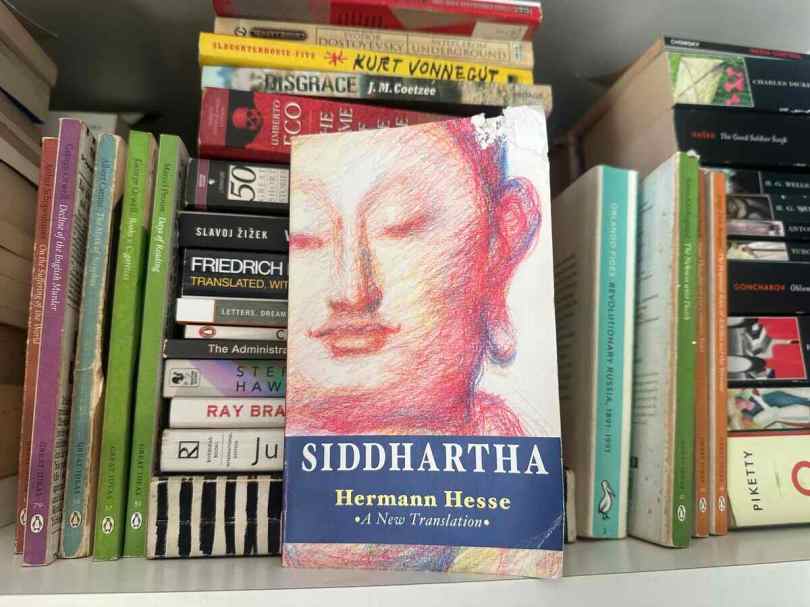
Quotes from Hermann Hesse's Siddhartha and What Nietzsche has in common with Buddha

Notes and Quotes from Hermann Hesse’s Siddhartha

Hermann Hesse’s Siddhartha is one of those books everyone must read. Not only because it’s a classic, nor because Hesse is the winner of the 1946 Nobel Prize in literature, but because reading Siddhartha will make the reader, whoever he is, (a tiny bit) wiser (even if he doesn’t plan on becoming a Buddhist).

Where Buddha and Nietzsche Briefly Meet

Sitting at my desk in my study, the book in my hands, I’m thinking about this quote:

Seeking means having a goal, but finding means being free, open, having no goal.

– Hermann Hesse, Siddhartha

Having a goal chains you to it…
Have no goal unchains you…

The goal is a target; to hit the target, one must aim at it; to aim at a target, one must focus on it alone; therefore, the person who has a goal only sees through the rifle scope that is aimed at the object; and consequently, the surrounding world, the one outside his field of vision, ceases to matter and eventually disappears. Any thing or event that cannot be linked to (or get him closer to) his object of desire is a distraction, an obstacle, a waste of time. The determined, enterprising man’s world is limited, small, so small that the free spirit (trapped in it) feels claustrophobic. He lives in the parameters of his goal. The aimless man’s world, on the other hand, is much larger, boundless — most importantly, much slower…

For a moment, we find ourselves at an intersection where Buddha and Nietzsche briefly meet. In Human, All Too Human, Nietzsche writes that “the unceasing desire to create is vulgar.” He then adds: “If a man is something, it is not really necessary to do anything — and yet he does a great deal. There is a human species higher even than the ‘productive’ man.”

More Quotes from Hesse’s Siddhartha:

The opposite of every truth is also just as true! It is like this: A truth can be expressed and cloaked in words only if it is one-sided. Everything that can be thought in thoughts and expressed in words is one-sided, only a half.

– Herman Hesse, Siddhartha

Wisdom is not expressible. Wisdom, when a wise man tries to express it, always sounds like foolishness.

– Hermann Hesse, Siddhartha

Let seeing through the world, explaining it, looking down on it, be the business of great thinkers. The only thing of importance to me is being able to love the world, without looking down on it, without hating it and myself — being able to regard it and myself and all beings with love, admiration, and reverence.

– Herman Hesse, Siddhartha
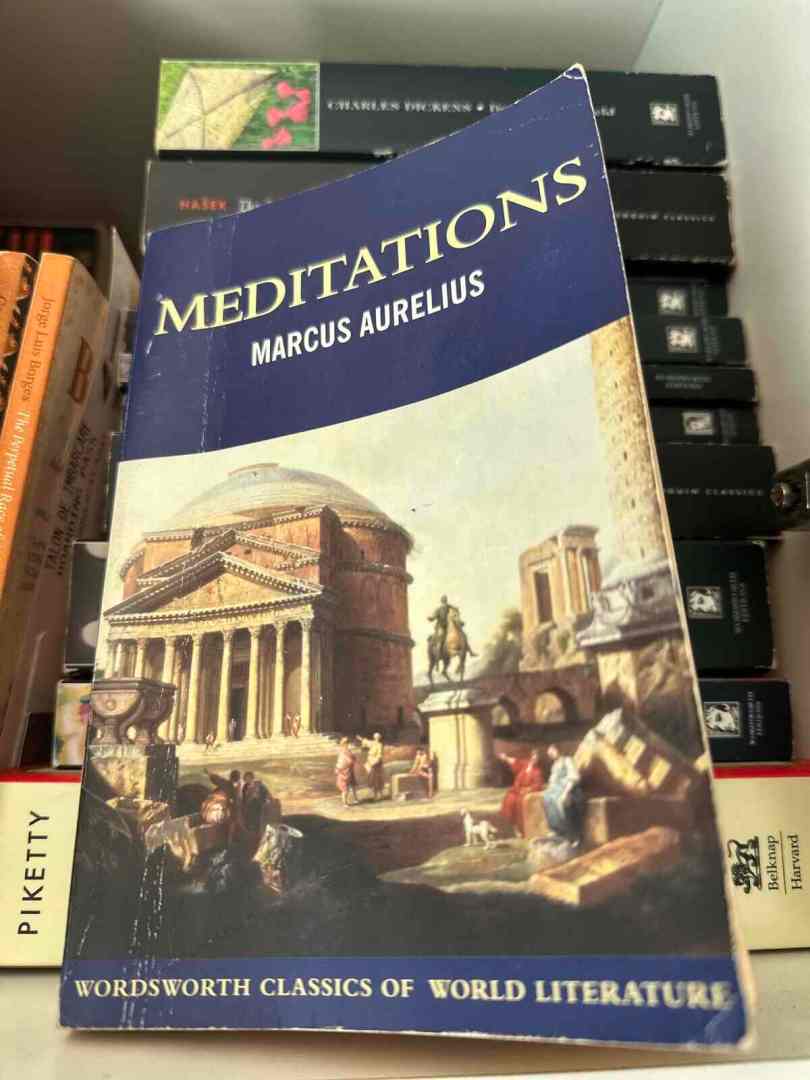
Marcus Aurelius on Death and Being Forgotten

Reading Marcus Aurelius: Don’t Forget that You’ll Be Forgotten

In Meditations1 in general, but especially in Book 7, Marcus Aurelius keeps reminding us that, no matter who we are and no matter what we do, sooner or later, we will be forgotten. My favorite quote summarizing this is:

Close is the time when you will forget all things; and close, too, the time when all will forget you.

– Marcus Aurelius, Meditations

But when one reads this as a standalone quote, one can may come to various conflicting conclusions. So, let’s look at the other quotes and see what we understand from them.

How many whose praises were once widely sung are now consigned to oblivion; and how many who sang their praises are now departed and gone?

– Marcus Aurelius, Meditations

Everything material disappears very swiftly into the universal substance, and swiftly too every cause is reabsorbed into the universal reason, and very swiftly the memory of everything is buried in eternity.

– Marcus Aurelius, Meditations

On fame: Look at the minds and see what they are like, and the sort of things that they flee from and those that they pursue. And reflect, too, that just as sand dunes are always drifting over one another and concealing what came before, so in life also, what comes earlier is very swiftly hidden by all that piles up afterwards.

– Marcus Aurelius, Meditations

And in another place, he says, “How many a Chrysippus, how many a Socrates, how many an Epictetus has time already engulfed.” And then, he also says things like, “In no time at all both you and the wrongdoer will be dead…”

So, what does it mean for the Stoic to remember that he’ll be forgotten? It is to be aware of his mortality and embrace it.

Some may say here, of course, that every adult on the planet knows that he’s eventually going to die. Yes, that is true; however, even with that knowledge, most live as if they’re never going to die. That is what separates the Stoic from the rest. As Ernest Becker puts it in The Denial of Death,2 “Everything that man does in his symbolic world is an attempt to deny and overcome his grotesque fate.” Conversely, we have the Stoic who wakes up every day and takes the pill that reminds him of his impermanence.

For the Stoic, freedom really begins when you stop desiring to be remembered, when you stop being afraid to be forgotten. That’s when you stop caring about the opinions of others and start living for yourself, doing good for its own sake.

To become a Stoic, one must first remember that he’ll be forgotten.


[1] Here I am again, revisiting Marcus Aurelius, reading Meditations. The last time I opened Meditations and shared quotes from it was years ago. But there’s something about this book that makes you want to pick it up again (and again). No wonder interest in Stoicism has spiked in recent years. A book that was written 2,000 years ago that is packed with great advice and a philosophy that comes in handy in the 21st century. (Although, in a book I read recently — The Tragic Mind by Robert D. Kaplan — I came across a passage that said Stoicism is a philosophy suited for slaves. This is, of course, something to think about… but later.)

[2] Becker, Ernest. The Denial of Death. The Free Press, 1997.

Smoking a cigar and drinking vodka at Tony's. The cigar is Plasencia Reserva Original.

Have a Cigar: Plasencia Reserva Original Robusto

Name: Plasencia Reserva Original Robusto

Country: Nicaragua

Shape: Parejo

Size: (4 3/4 inches x 52)

Strength: Mild

Words preserved in pages
like torshi seer in mason jars
don’t mean
what they used to mean.
But they are much more meaningful now.

Not all cigars are burning poems.
Some of them are hourglasses.
Others are daydreams.

Their purpose changes.

Who has a raison d’être? Show me.
Isn’t the meaning constantly changing?
Are you here for the same reason
you were here yesterday?
Even if you think so, you’re not.
You don’t have a purpose,
you have many;
therefore, none at all.