Quote from Soren Kierkegaard's Fear and Trembling

Quotes from Soren Kierkegaard’s Fear and Trembling

Here are five great quotes from Kierkegaard’s Fear and Trembling:

One became great through expecting the possible, another by expecting the eternal; but he who expected the impossible became greater than all.

– Soren Kierkegaard, Fear and Trembling

Whatever one generation learns from another, it can never learn from the predecessor the genuinely human factor. In this respect every generation begins afresh, has no task other than that of any previous generation, and comes no further, provided the latter didn’t shirk its task and deceive itself.

– Soren Kierkegaard, Fear and Trembling

Fools and young people talk about everything being possible for a human being. But that is a great mistake. Everything is possible spiritually speaking, but in the finite world there is much that is not possible.

– Soren Kierkegaard, Fear and Trembling

All that can save him is the absurd; and this he grasps by faith.

– Soren Kierkegaard, Fear and Trembling

No person who has learned that to exist as the individual is the most terrifying thing of all will be afraid of saying it is the greatest.

– Soren Kierkegaard, Fear and Trembling

Sisyphus Brings Happiness to the Working-Class Man: Notes and Quotes from A Happy Death by Albert Camus

In The Myth of Sisyphus, Albert Camus writes that “all great deeds and all great thoughts have a ridiculous beginning.” This is what I have in mind when I read A Happy Death, which I consider to be the ridiculous beginning of his later works, especially The Stranger and The Myth of Sisyphus.

Summary of Albert Camus’s A Happy Death

A Happy Death is a short novel by Camus that was published posthumously in 1971, 11 years after the author’s death. It is about a man actively chasing happiness. His name is Patrice Mersault. He is driven by his will to happiness, and he is prepared to do anything to attain his goal, even kill. He believes that once he has time and money, he can finally be happy. The day-to-day stuff, like his work, is keeping him from actualizing his happiness. He wants to be free. Mersault says vehemently, “I have my life to earn. My work — those eight hours a day other people can stand — my work keeps me from doing it.” (And isn’t this, at least subconsciously, the hypothesis of Everyman? Everyone I’ve ever met who works a traditional nine-to-five job has a plan or a dream to become a free man one day. These men can (or will) only be happy when they have enough money to finally own themselves, when they become free to spend their time and energy the way they desire. But the majority of these men are money worshippers who lack faith. They pray but don’t believe. They are not willing to do everything to be free; they can stand the “eight hours a day” and, therefore, will never be free.) Mersault’s “will to happiness” leads him to kill a rich man and take his money, which enables him to live a happy life. “Like warm dough being squeezed and kneaded, all he wanted was to hold his life between his hands.” And he gets what he wants.

(Patrice Mersault is a go-getter who can be gently compared to Daniel Lugo from Pain & Gain, the 2013 movie directed by Michael Bay, in which a gang of bodybuilders spoil themselves with the riches of a man (they think) they killed.)

We can summarize A Happy Death as follows: the protagonist wants to be happy but doesn’t have the means (time and money), so he kills a rich man, takes his money, and basically opts for an early retirement. He takes regular swims and long walks along the beach and spends a lot of time with women. He builds a happiness routine and, at one point, talking to one of his girlfriends, he says, “Yes, I’m happy, in human terms.” And, of course, the book ends with Mersault’s death, which is — the title of the book — a happy death.

The Working Class Man’s Fantasy

What is A Happy Death? It is the working-class man’s fantasy: you’re suddenly rich (because you won the lottery or robbed a bank or whatever), and now you can do whatever the hell you want. You don’t have to sell your time anymore. You don’t have to work. You can now exit the matrix. You are finally free.

One character called Celeste, although he is a restaurant owner and not technically a working-class man, when he is asked what he would do if he suddenly got a lot of money, says, “I’d buy myself a hut out in the country, I’d put some glue in my navel and I’d stick a flag in there. Then I’d wait to see which way the wind was blowing.” Although he is being funny, isn’t what he is saying the big dream a lot of us share? Being (financially) independent, being (absolutely) free, et cetera.

Yes, it is the dream, but it’s also a mistake.

For the mistake is thinking that that quantity of experiences depends on the circumstances of our life when it depends solely on us. Here we have to be over simple. To two men living the same number of years, the world always provides the same sum of experiences. It is up to us to be conscious of them. Being aware of one’s life, one’s revolt, one’s freedom, and to the maximum, is living, and to the maximum.

— Albert Camus, The Myth of Sisyphus

Sisyphus Brings Happiness to the Working-Class Man

Patrice Mersault has “become aware of the essential and immoral truth that money is one of the surest and swiftest means of acquiring one’s dignity.” Money is the means by which one actualizes his inner self, i.e., externalizes it to make it part of the physical world.

In his book on identity called Identity: Contemporary Identity Politics and the Struggle for Recognition, Francis Fukuyama writes:

The foundations of identity were laid with the perception of a disjunction between one’s inside and one’s outside. Individuals come to believe that they have a true or authentic identity hiding within themselves that is somehow at odds with the role they are assigned by their surrounding society.

And to clarify it further, Fukuyama adds: “Oftentimes an individual may not understand who that inner self really is, but has only the vague feeling that he or she is being forced to live a lie.”

Mersault felt like he was being forced to live a lie. “My work keeps me from doing it,” he says. His work keeps him from earning his life, and the only way to actualize his inner self, to unchain his “will to happiness,” is by acquiring money.

In the first part of the book, in a conversation with Zagreus (the rich man Mersault ends up killing), we observe how lost Mersault is. Like many of us who nurse pints of beer in bars after working hours, he feels trapped and doesn’t know what to do. He says, “I feel like getting married, or committing suicide, or else subscribing to L’Illustration. Something desperate, you know.” Zagreus smiles and blames it on Mersault’s poverty. Then Zagreus compares himself to Mersault. Zagreus has all the resources, but he is crippled and cannot enjoy life. Mersault, on the other hand, is his opposite: he has the body to enjoy life but not the resources. “Your one duty is to live and be happy,” Zagreus tells Mersault, and the latter laughs. He says he cannot do that because of his eight-hour shifts and that it would be different if he were free. And here, it becomes crystal clear for us readers why Mersault ends up killing Zagreus to take his money and why it is “okay” to kill Zagreus (because he cannot live anyway).

But is being financially free a prerequisite to happiness? That is the question we need to ask after reading A Happy Death. Can the man who sells his time for money — the employee — never be happy? If so, then happiness is not accessible to the working-class man, not even to the middle-class man. Only the millionaire or the billionaire who chooses to abandon the business world can be free and, therefore, happy. That’s what we conclude from reading A Happy Death. In The Myth of Sisyphus, however, Camus changes everything. He writes, “One must imagine Sisyphus happy.” This is the sentence that undermines A Happy Death. When we are allowed to imagine Sisyphus — “the futile laborer of the underworld” — happy, we can finally also see that the working-class man can eventually attain happiness.

Of course, this does not mean that we must cease rebelling. It does not mean we must stupidly embrace (fake) stoicism. It does not mean that we must surrender our freedom. But maybe we’ll talk about this another time… I will give you the quotes now and go crack open a cold one.

Quotes from A Happy Death by Albert Camus

In this flowering of air, this fertility of the heavens, it seemed as if a man’s one duty was to live and be happy.

— Albert Camus, A Happy Death

‘Only it takes time to be happy. A lot of time. Happiness, too, is a long patience. And in almost every case, we use up our lives making money, when we should be using our money to gain time.’

— Albert Camus, A Happy Death

‘Don’t think I’m saying that money makes happiness. I only mean that for a certain class of beings happiness is possible, provided they have time, and that having money is a way of being free of money.’

— Albert Camus, A Happy Death

He knew now that it was his own will to happiness which must make the next move. But if it was to do so, he realized that he must submit to time, that to come to terms with time was at once the most magnificent and the most dangerous of experiments. Idleness is fatal only to the mediocre.

— Albert Camus, A Happy Death

There must be a minimum of ignorance in order to perfect a life in happiness. Those who lack such a thing must set about acquiring it: unintelligence must be earned.

— Albert Camus, A Happy Death

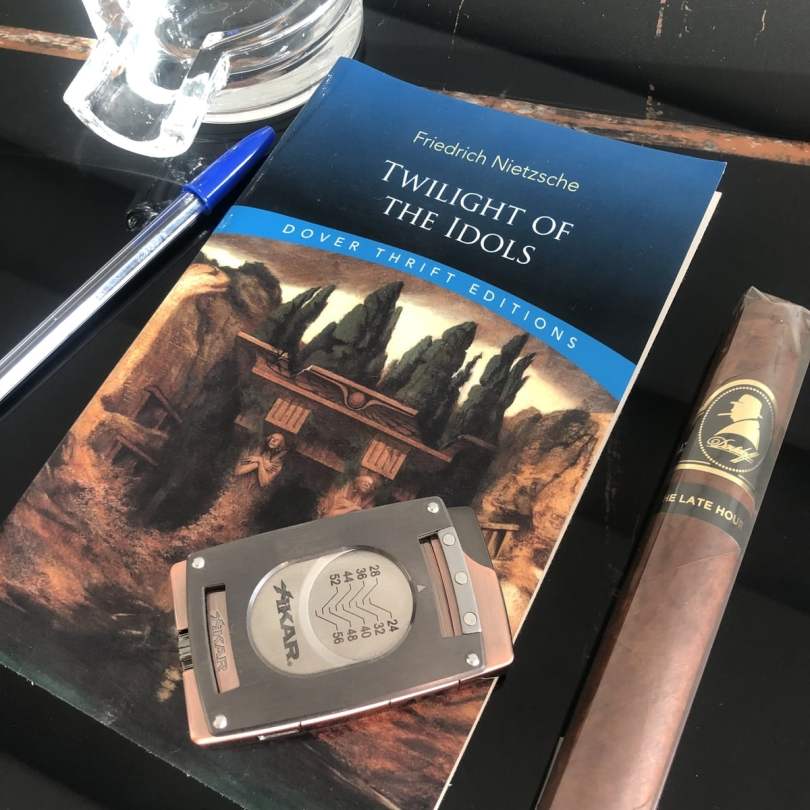
Reading Friedrich Nietzsche's Twilight of the Idol and Smoking a Cigar

Thoughts On Nietzsche’s Twilight of the Idols, Some Personal Notes, and Other Less Important Notes

A Strange Conversation

“God is dead,” said Friedrich Nietzsche whose father and grandfathers were clergymen. When the psychologist I met at a bar on Hamra Street learned about this, he said, “Aha! We can say that here, too, Freud was right.” Nietzsche was only four years old when his father died. Therefore, the only way for him to re-enact the story of Oedipus was to kill what his father believed in — God, or, as the Germans call him, Gott. That was, at least, what the drunken psychologist hypothesized before ordering another drink.

It is also known that Nietzsche disliked women. That will be clear to anyone who reads his works. “But who can blame him?” The psychologist said. “He grew up with a lot of women around, you said, no?” Mother, sister, grandmother, aunts. My Gott! The list is long. “But let’s not justify sexism here. Let’s pay the bill and leave this bar.”

On Twilight of the Idols

They say that Nietzsche wrote Twilight of the Idols in less than 10 days. When I read that, I was like, “That man really had nothing more entertaining to do than to sit and write.” But, at the same time, I was impressed. In fact, I envied him a little. I’ve been wanting to write a book for years, and I have nothing to show for it.

I also read that, with Twilight of the Idols, Nietzsche’s goal was to write a short introduction to his philosophy. But, after reading most of his works, in my humble opinion, I can say that he has failed to do so. Human, All Too Human is likely a better introduction to his philosophy. When someone who has never read Nietzsche asks me what to start with, I always suggest Human, All Too Human, and, in some cases, Thus Spoke Zarathustra. Otherwise, they will not grasp what Nietzsche is all about.

Now, surely you have come across the dictum that says, “Whatever doesn’t kill me makes me stronger.” Have you ever wondered where that came from? If you did, then now you have an answer. You have found the book where that quote — the one that Instagram influencers use so frequently — came from! The book is called Twilight of the Idols, or, How to Philosophize with a Hammer.

“How to philosophize with a hammer.” How wonderful.

On Scholars

The worst mistake you can do in life is to study philosophy. I wouldn’t suggest you major in philosophy unless you want to live a lousy life. Philosophy is dead to everyone except philosophers. “Philosophy and necrophilia,” the drunken psychologist once told me, “have a lot in common.” He didn’t elucidate though. In philosophy, the best you can be is Slavoj Žižek; the worst you can be is also Slavoj Žižek. In the end, it’s up to you. Be who you want to be.

Besides, I advise you not to take my advice.

How many bottles of wine have I had writing this? I didn’t count.

But I guess all I wanted to say is this: Scholars are fetishists. They don’t read philosophy like an average human being ought to. When you read philosophy, read like a human. Remember that.

Thoughts on Twilight of the Idols

“Apophthegms and Darts,” which is the first section of Twilight of the Idols, is filled with maxims covering numerous topics, many of which are more ridiculous than they are shocking or thought provoking. So I am not going to spend a lot time on them. However, I will quote a few of them below for you to read with your own eyes.

How is it? Is man only a mistake of God? Or God only a mistake of man? —

From the military school of life. — What does not kill me, strengthens me.

To live alone, one must be an animal or a God — says Aristotle. The third case is wanting: one must be both — a philosopher.

As you can see, there’s not much to talk about there. But we can say a few words about the subsequent section called “The Problem of Socrates.” Actually, I find it very funny. To defeat Socrates, Nietzsche calls the Greek philosopher “ugly.” He first turns Socrates into a joke, and then adds that “ugliness is often enough the expression of a thwarted development checked by cross breeding.” But he doesn’t stop there. No. Nietzsche keeps swinging his hammer like a lousy internet troll who just wants to make people feel bad about themselves. He adds that criminologists and anthropologists (of his time, of course) have found that “the typical criminal is ugly.” And so Nietzsche expects us to conclude something like this: Socrates is an ugly criminal.

If Nietzsche were on Twitter he would have been “cancelled.”

“Socrates wanted to die,” he writes. “Athens did not give him the poison cup; he gave it to himself; he compelled Athens to give it to him.”

I don’t know about you, but I laughed so hard when I read this.

Another thing that made me laugh comes under the section called “Morality as Antinaturalness.” There he says, “We no longer admire the dentist who pulls out the teeth, that they may no longer cause pain.” When I read this, I suddenly remembered that I haven’t been brushing my teeth. So I immediately put down the book and went to brush my teeth. Boy, was I drunk! I didn’t recognize myself in the mirror…

In the final pages of the book, I came across something that made me very happy. I read the sentence: “Dostoiewsky, the only psychologist, let it be said, from whom I had anything to learn…”

This made me smile like an idiot. And I caught myself nodding as if I discovered something epic. “Well,” I said, “I hope this Dostoiewsky is the Dostoevsky I know. Nietzsche calling Dostoevsky the only true psychologist he knows is amazing! It all makes sense now. I will share this with all my friends.”

Then I passed out for some time.

But here I am again, now, and I will end this entry with the best quote from Twilight of the Idols.

The individual, in his antecedents and in his consequents, is a piece of fate, an additional law, an additional necessity for all that now takes place and will take place in the future. To say to him, “Alter thyself,” is to require everything to alter itself, even backward also.

***

Read more on Nietzsche’s Twilight of the Idols here.