Marcus Aurelius on Death and Being Forgotten

Reading Marcus Aurelius: Don’t Forget that You’ll Be Forgotten

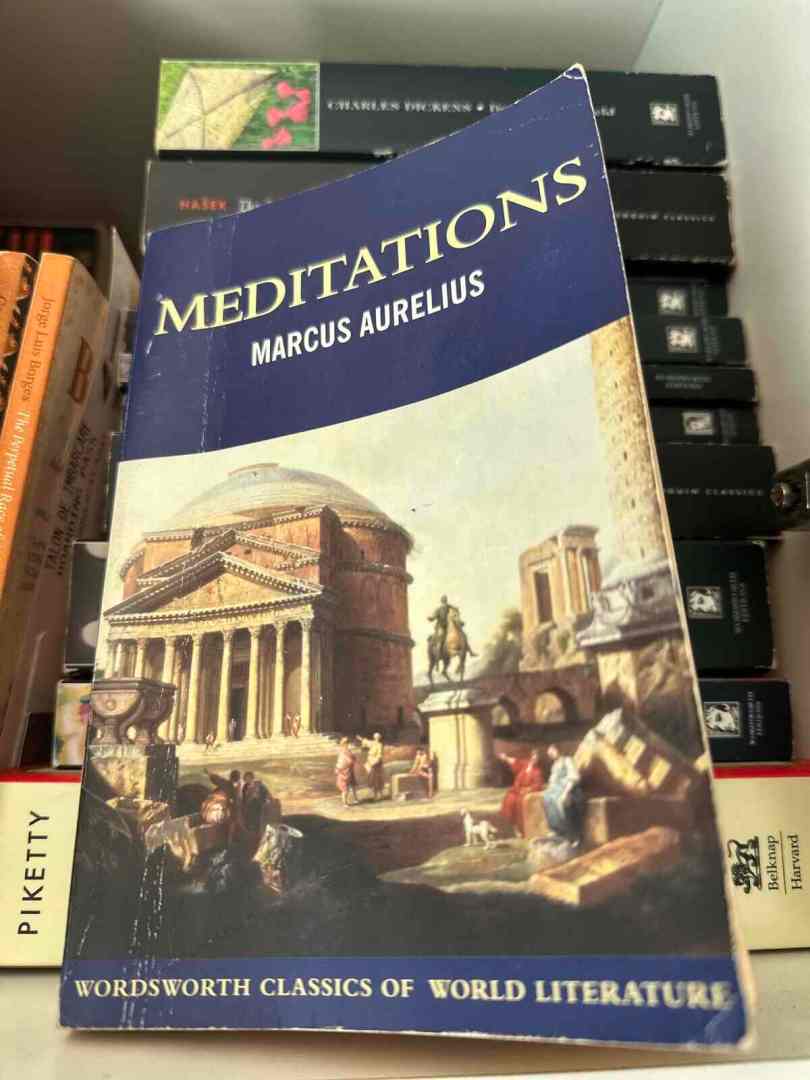
In Meditations1 in general, but especially in Book 7, Marcus Aurelius keeps reminding us that, no matter who we are and no matter what we do, sooner or later, we will be forgotten. My favorite quote summarizing this is:

Close is the time when you will forget all things; and close, too, the time when all will forget you.

– Marcus Aurelius, Meditations

But when one reads this as a standalone quote, one can may come to various conflicting conclusions. So, let’s look at the other quotes and see what we understand from them.

How many whose praises were once widely sung are now consigned to oblivion; and how many who sang their praises are now departed and gone?

– Marcus Aurelius, Meditations

Everything material disappears very swiftly into the universal substance, and swiftly too every cause is reabsorbed into the universal reason, and very swiftly the memory of everything is buried in eternity.

– Marcus Aurelius, Meditations

On fame: Look at the minds and see what they are like, and the sort of things that they flee from and those that they pursue. And reflect, too, that just as sand dunes are always drifting over one another and concealing what came before, so in life also, what comes earlier is very swiftly hidden by all that piles up afterwards.

– Marcus Aurelius, Meditations

And in another place, he says, “How many a Chrysippus, how many a Socrates, how many an Epictetus has time already engulfed.” And then, he also says things like, “In no time at all both you and the wrongdoer will be dead…”

So, what does it mean for the Stoic to remember that he’ll be forgotten? It is to be aware of his mortality and embrace it.

Some may say here, of course, that every adult on the planet knows that he’s eventually going to die. Yes, that is true; however, even with that knowledge, most live as if they’re never going to die. That is what separates the Stoic from the rest. As Ernest Becker puts it in The Denial of Death,2 “Everything that man does in his symbolic world is an attempt to deny and overcome his grotesque fate.” Conversely, we have the Stoic who wakes up every day and takes the pill that reminds him of his impermanence.

For the Stoic, freedom really begins when you stop desiring to be remembered, when you stop being afraid to be forgotten. That’s when you stop caring about the opinions of others and start living for yourself, doing good for its own sake.

To become a Stoic, one must first remember that he’ll be forgotten.


[1] Here I am again, revisiting Marcus Aurelius, reading Meditations. The last time I opened Meditations and shared quotes from it was years ago. But there’s something about this book that makes you want to pick it up again (and again). No wonder interest in Stoicism has spiked in recent years. A book that was written 2,000 years ago that is packed with great advice and a philosophy that comes in handy in the 21st century. (Although, in a book I read recently — The Tragic Mind by Robert D. Kaplan — I came across a passage that said Stoicism is a philosophy suited for slaves. This is, of course, something to think about… but later.)

[2] Becker, Ernest. The Denial of Death. The Free Press, 1997.

Wine Review Lebanon: Mont D'Almaz Chateau 2019

Lebanese Wines: Mont D’Almaz Chateau 2019

Name: Mont D’Almaz Chateau 2019
Type: Red Wine
Grapes: Cabernet Sauvignon, Merlot, Syrah
Year: 2019
Country: Lebanon
Region: Mount Lebanon
Date Consumed: October 10, 2025

I had this with my wife and friends at a bar in Gemmayze called Import Export. They had a nice selection of local and international wines. We chose the Mont D’Almaz Chateau 2019 as our first bottle, a wine none of us had tried before… and it turned out to be an excellent choice. All of us loved it.

It’s a dark, ruby-red, full-bodied wine with assertive (but courteous) tannins and medium acidity. It comes with notes of red fruits, black cherry, oak, and some pleasant hints of spices.

We paired it with cold cuts, cheeses, and jokes.

Book Review and Quotes from Atul Gawande's Being Mortal

Notes and Quotes from Atul Gawande’s Being Mortal

This morning, I spent some time reorganizing my bookshelves before the start of my workday. Reorganizing my books relaxes me. It’s like a mindfulness session, if you know what I mean. So, sometimes, I do it for that reason alone.

When I picked up Atul Gawande’s Being Mortal: Medicine and What Matters in the End, I began to flip through its pages and went on reading the sentences I had underlined years ago. I remember loving the book. I remember reading it back when I was “studying” death: What is the meaning of death? How does the awareness and the fear of death affect us? What is the death instinct? How does one prepare to die? Etc. Besides the classics like Ernest Becker’s The Denial of Death and Sigmund Freud’s Beyond the Pleasure Principle, Gawande’s Being Mortal was one of the books I ended up reading.

Being Mortal talks about aging and the inevitable conclusion of life. More precisely, it talks about what medicine can do about these inescapable realities.

Here I am now, sharing, for no particular reason and after so many years, some of the sentences I had underlined, and they are not necessarily about death…

First Quote

Nothing that takes off becomes quite what the creator wants it to be. Like a child, it grows, not always in the expected direction.

– Atul Gawande, Being Mortal

I like this quote because it can live outside the book it was created for. Even when used out of context, it still delivers a philosophical insight. In a way, it does not need its surrounding words; on the contrary, its surrounding words become more meaningful when it is added to them… So, let us take this quote and walk out of the book for a moment. Doesn’t it make us want to ask the following: Can the creation transcend what it was created for? And is not the answer a resounding yes? Think about it.

Second Quote

The only way death is not meaningless is to see yourself as part of something greater: a family, a community, a society. If you don’t, mortality is only a horror. But if you do, it is not.

– Atul Gawande, Being Mortal

Aloneness will, sooner or later, swallow us whole if we don’t chain ourselves to an idea that is larger than life. One cannot live a fulfilling life without believing in something. As they say, a good reason to live for is simultaneously a good reason to die for.

Third Quote

All we ask it to be allowed to remain the writers of our own story. That story is ever changing. Over the course of our lives, we may encounter unimaginable difficulties. Our concerns and desires may shift. But whatever happens, we want to retain the freedom to shape our lives in ways consistent with our character and loyalties.
This is why the betrayals of body and mind that threaten to erase our character and memory remain among our most awful tortures.

– Atul Gawande, Being Mortal

Gawande repeats this idea in different parts of the book. I’d even say that he repeats it more poetically elsewhere. Don’t worry, however; the quote I chose delivers the message clearly. What Gawande keeps communicating throughout the book is that life becomes meaningful when it feels like a story. When you lose chapters of your story or when you’re no longer able to connect the dots of your self, life loses its meaning. Life doesn’t only end when one’s story ends. Life also (figuratively) ends when it ceases being a story.

Fourth Quote

Patients tend to be optimists, even if that makes them prefer doctors who are more likely to be wrong.

– Atul Gawande, Being Mortal

This is already observable with the naked eye: A person has the tendency to prefer the flatterer over the critic. But those who plan on becoming better, must eventually leave behind the former and listen to the latter.