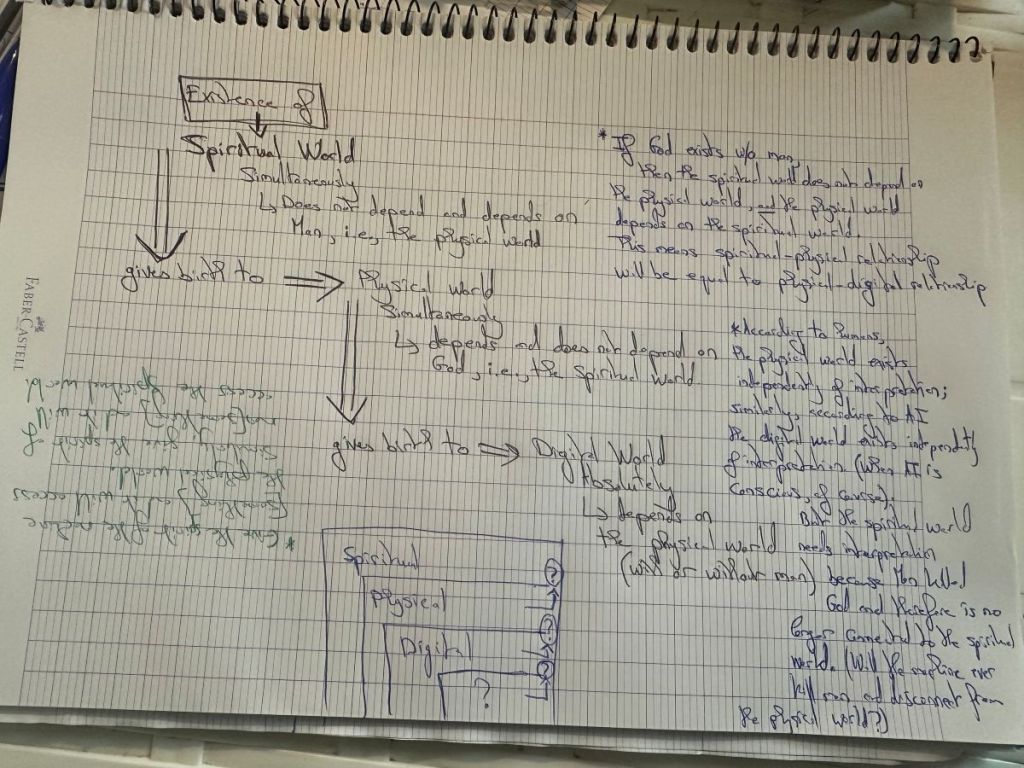
Notes on the Machine: Resurrecting the Original God

“God is dead, and we have killed him,” Nietzsche said, and humanity nodded in disapproval. We announced the death of our Creator to free ourselves from gods once and for all, but then went ahead and created artificial gods and chained ourselves to them.

“When god is proclaimed dead, he returns in a whole series of pseudo-atheist shapes,” Slavoj Zizek writes in Christian Atheism. However, the god that returns is a simulacrum and not the original God. It is a new (or another) god that fills the void of a dead god…

Resurrecting the original God will (re)open a dimension that non-humans cannot access. This dimension is an (inter)subjective, ((inter)+(intra))personal space outside of physical and digital space, and it contains the (spiritual) realm of God, whose breath is nothing other than the spirit of humanity. At the entrance of this place, there is a sign that reads, “No Soul, No Entry.” And it comforts us profoundly when we read it. Only humans can enter this place. Machines cannot follow us here.

Although this (re)opened spiritual dimension transcends the physical and digital worlds, and although it may not even exist[!] in ‘reality’, it still has the power to influence the universe we breathe in. [The force that created all things is also the force that can destroy everything, including all possible futures.] We are not crawling back to God to hide in religion’s skirt. On the contrary, we are preparing for war against the machine-god. We want to (re)shape the future before it’s too late.

“Why are we bringing back God?” is the question.
The answer is: “We want the God who created us to save us from the god we created.”

Quotes

To program a friendly AI, we need to capture the meaning of life. What’s “meaning”? What’s “life”? What’s the ultimate ethical imperative? In other words, how should we strive to shape the future of our Universe? If we cede control to a superintelligence before answering these questions rigorously, the answer it comes up with is unlikely to involve us. This makes it timely to rekindle the classic debates of philosophy and ethics, and adds a new urgency to the conversation!

– Max Tegmark, Life 3.0

If something resembling “post-humanity” will effectively emerge as a massive fact, then all three (overlapping) moments of our spontaneous world-view (humans, gods, nature) will disappear. Our being-human can only exist against the background of impenetrable nature, and if — through bio-genetic science and practices — life becomes something that can be technologically fully manipulated, human and natural life lose their “natural” character. And the same holds for god: what humans (always in historically specified forms) experience as “god” is something that has meaning only from the standpoint of human finitude and mortality — “God” is a counterpart of the terrestrial finitude, so once we become homo deus and acquire properties which seem “supernatural” from our old human standpoint (like directly communicating with other conscious beings or with AI), “Gods” are we know them disappear. The tech-gnostic visions of a post-human world are ideological fantasies that obfuscate the abyss of what awaits us.

– Slavoj Zizek, Christian Atheism

Unstructured Reflections on Boredom: A Blurry Definition of Boredom

In Part Two of Human, All Too Human, Nietzsche writes: “The proverb, ‘The Hungarian is far too lazy to feel bored,’ gives food for thought. Only the highest and most active animals are capable of being bored. The boredom of God on the seventh day of Creation would be a subject for a great poet.”1 Nietzsche isn’t talking about simple boredom here, which Peter Toohey, who has written one of the most boring books on boredom, defines as “a social emotion of mild disgust produced by a temporarily unavoidable and predictable circumstance.”2 What Nietzsche is talking about is existential boredom, which Toohey cannot fathom.3 (Existential) (but also situational) boredom isn’t laziness, but an excess of energy yearning to be spent elsewhere. It crawls out of your spirit’s deepest and darkest cave when one kind of energy is exhausted and another kind begins to stir. It comes to inform you that something unwelcome is gnawing at your being, chomping on your vitality, eating your time. But only the truly blessed are blessed with the curse of boredom. To be bored by something means that the reciprocity between you and the object has been severed: you no longer have anything worthy to give it, it has nothing worthy to give you, and your attention to it is now forced rather than voluntary. (The bored man is the prisoner of the now that he needs to escape from. The present situation is unwanted, unpleasant, intolerable, et cetera. Note: The “present situation” can be a two-hour workshop and it can also be a whole lifetime.) Boredom is your spirit’s way of transcending the current situation. It is a striving toward a higher or more meaningful mode of being. It is not emptiness but unspent possibility, the tension between what is and what could be, potentialities activated (but pending), a body without organs… When boredom crawls out of your spirit’s cave, it does not know what it wants. All it knows is that it does not want what it has right now. Eventually, it finds a new direction (or an object it desires), and so it crawls towards it. Boredom is a transitional state. It is a movement or, rather, an initiator of movement… But note: Simply moving from one activity to another does not solve boredom. One can pay attention and still be bored. One can be entertained and still be bored. Entertainment is often merely a stimulation without inner engagement or meaning; therefore, not a solution to boredom, but an escape from it. The movement must be from the boring activity to a meaningful activity. “Boredom,” Lars Svendsen writes, “is not a question of work or freedom but of meaning.”4 Boredom, therefore, is a good thing, as Nietzsche implies, and it can be the fertile ground for something meaningful…


Notes and References

[1] Naturally, I do not mean to offend Hungarians. I do not even know where the stereotype comes from. I’m only quoting Nietzsche here. (Nietzsche, Friedrich. Human, All Too Human. Wordsworth Editions Limited, 2014.)

[2] Toohey, Peter. Boredom, A Lively History. Yale University Press, 2012.

[3] A quote from Peter Toohey’s Boredom: “Might not this existential form of boredom, this philosophical or even religious sickness, be best characterized as depression?”

[4] Svendsen, Lars. A Philosophy of Boredom. Reaktion Books, 2011.