The Real Nightmare Begins When You Wake Up

You don’t wake up from a nightmare; you wake into one. This is one of the first things we learn from reading Franz Kafka’s works.

In The Metamorphosis, Gregor Samsa wakes up from a nightmare to find himself in one far worse than the one he was dreaming: he discovers that he has metamorphosed into a monstrous insect. In The Trial, Joseph K. wakes up to find himself arrested without committing a crime or doing anything wrong. In The Castle, K. is woken by a young man who, out of nowhere, tells him that he needs permission from the Castle to sleep where he is already sleeping because everything, including the inn, belongs to the Castle.

When you scratch the surface of (the experienced) reality, the Kafkaesque is what you’ll get. The Kafkaesque is this ridiculously complex and illogical universe that the simulation (i.e., world) we’re in is based on. Everything in the simulation is logical and can be explained to a five-year-old until you look at the code.

The simulation we’re in is the experienced reality but not reality itself, (and it doesn’t necessarily have to be a computer simulation). As Kant would put it, it is the phenomenon but not the noumenon. The simulation hides the nightmarish qualities of the Kafkaesque, which lies beneath the surface of the experienced reality and is where what doesn’t make sense doesn’t make sense again.

In the world of our experienced reality, we live as if everything makes sense, but we’re just not thinking about it at the moment, when, in reality, experienced reality will collapse as soon as we start thinking about it. That’s how you scratch its surface, by THINKING. “Beginning to think is beginning to be undermined,” Albert Camus writes in The Myth of Sisyphus. When we start to think (to doubt), we will find ourselves standing next to Descartes, losing our minds (actually, losing everything but our minds) in a world created by some evil genius. “I shall consider that the heavens, the earth, colors, figures, sound, and all other external things are nought but the illusions and dreams of which this evil genius has availed himself in order to lay traps for my credulity,” writes Descartes in Meditations on First Philosophy.

When what doesn’t make sense doesn’t make sense again, that’s when we know we’re on our way to (re)discover the [what?].

Between experienced reality and reality itself, there is the Kafkaesque. All those who “exit” the simulation find themselves in it. Waking up in the Kafkaesque, however, does not mean you’re fully awake. The first time you wake up, you enter the nightmare. But the journey doesn’t end there. Beyond the nightmare, another world awaits…

Unfortunately, like Kafka’s protagonists, we eventually always choose to continue living as usual even in the nightmare, as if the status quo was never disturbed, as if everything unquestionably makes sense, as if “it’s just the way the world works”, as if “this is life”, as if there are no other ways to live than default living. That’s what makes the Kafkaesque truly Kafkaesque, living ordinarily even when we find ourselves in the extraordinary.

And just as a captive who in sleep enjoys an imaginary liberty, when he begins to suspect that his liberty is but a dream, fears to awaken, and conspires with these agreeable illusions that the deception may be prolonged, so insensibly of my own accord I fall back into my former opinions, and I dread awakening from this slumber…

— Rene Descartes, Meditations on First Philosophy


This piece was first published on my Substack on March 25, 2026.

Quotes from Hermann Hesse's Siddhartha and What Nietzsche has in common with Buddha

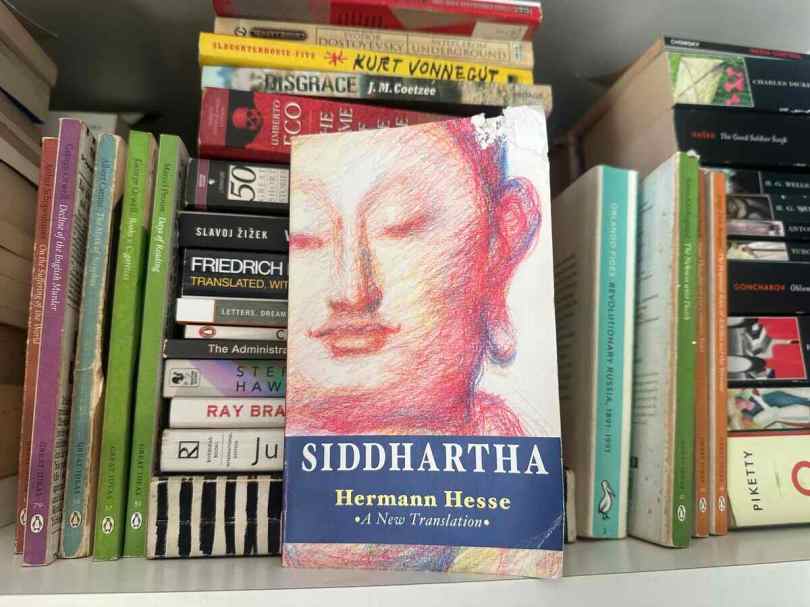
Notes and Quotes from Hermann Hesse’s Siddhartha

Hermann Hesse’s Siddhartha is one of those books everyone must read. Not only because it’s a classic, nor because Hesse is the winner of the 1946 Nobel Prize in literature, but because reading Siddhartha will make the reader, whoever he is, (a tiny bit) wiser (even if he doesn’t plan on becoming a Buddhist).

Where Buddha and Nietzsche Briefly Meet

Sitting at my desk in my study, the book in my hands, I’m thinking about this quote:

Seeking means having a goal, but finding means being free, open, having no goal.

– Hermann Hesse, Siddhartha

Having a goal chains you to it…
Have no goal unchains you…

The goal is a target; to hit the target, one must aim at it; to aim at a target, one must focus on it alone; therefore, the person who has a goal only sees through the rifle scope that is aimed at the object; and consequently, the surrounding world, the one outside his field of vision, ceases to matter and eventually disappears. Any thing or event that cannot be linked to (or get him closer to) his object of desire is a distraction, an obstacle, a waste of time. The determined, enterprising man’s world is limited, small, so small that the free spirit (trapped in it) feels claustrophobic. He lives in the parameters of his goal. The aimless man’s world, on the other hand, is much larger, boundless — most importantly, much slower…

For a moment, we find ourselves at an intersection where Buddha and Nietzsche briefly meet. In Human, All Too Human, Nietzsche writes that “the unceasing desire to create is vulgar.” He then adds: “If a man is something, it is not really necessary to do anything — and yet he does a great deal. There is a human species higher even than the ‘productive’ man.”

More Quotes from Hesse’s Siddhartha:

The opposite of every truth is also just as true! It is like this: A truth can be expressed and cloaked in words only if it is one-sided. Everything that can be thought in thoughts and expressed in words is one-sided, only a half.

– Herman Hesse, Siddhartha

Wisdom is not expressible. Wisdom, when a wise man tries to express it, always sounds like foolishness.

– Hermann Hesse, Siddhartha

Let seeing through the world, explaining it, looking down on it, be the business of great thinkers. The only thing of importance to me is being able to love the world, without looking down on it, without hating it and myself — being able to regard it and myself and all beings with love, admiration, and reverence.

– Herman Hesse, Siddhartha

Unstructured Reflections on Boredom: A Blurry Definition of Boredom

In Part Two of Human, All Too Human, Nietzsche writes: “The proverb, ‘The Hungarian is far too lazy to feel bored,’ gives food for thought. Only the highest and most active animals are capable of being bored. The boredom of God on the seventh day of Creation would be a subject for a great poet.”1 Nietzsche isn’t talking about simple boredom here, which Peter Toohey, who has written one of the most boring books on boredom, defines as “a social emotion of mild disgust produced by a temporarily unavoidable and predictable circumstance.”2 What Nietzsche is talking about is existential boredom, which Toohey cannot fathom.3 (Existential) (but also situational) boredom isn’t laziness, but an excess of energy yearning to be spent elsewhere. It crawls out of your spirit’s deepest and darkest cave when one kind of energy is exhausted and another kind begins to stir. It comes to inform you that something unwelcome is gnawing at your being, chomping on your vitality, eating your time. But only the truly blessed are blessed with the curse of boredom. To be bored by something means that the reciprocity between you and the object has been severed: you no longer have anything worthy to give it, it has nothing worthy to give you, and your attention to it is now forced rather than voluntary. (The bored man is the prisoner of the now that he needs to escape from. The present situation is unwanted, unpleasant, intolerable, et cetera. Note: The “present situation” can be a two-hour workshop and it can also be a whole lifetime.) Boredom is your spirit’s way of transcending the current situation. It is a striving toward a higher or more meaningful mode of being. It is not emptiness but unspent possibility, the tension between what is and what could be, potentialities activated (but pending), a body without organs… When boredom crawls out of your spirit’s cave, it does not know what it wants. All it knows is that it does not want what it has right now. Eventually, it finds a new direction (or an object it desires), and so it crawls towards it. Boredom is a transitional state. It is a movement or, rather, an initiator of movement… But note: Simply moving from one activity to another does not solve boredom. One can pay attention and still be bored. One can be entertained and still be bored. Entertainment is often merely a stimulation without inner engagement or meaning; therefore, not a solution to boredom, but an escape from it. The movement must be from the boring activity to a meaningful activity. “Boredom,” Lars Svendsen writes, “is not a question of work or freedom but of meaning.”4 Boredom, therefore, is a good thing, as Nietzsche implies, and it can be the fertile ground for something meaningful…


Notes and References

[1] Naturally, I do not mean to offend Hungarians. I do not even know where the stereotype comes from. I’m only quoting Nietzsche here. (Nietzsche, Friedrich. Human, All Too Human. Wordsworth Editions Limited, 2014.)

[2] Toohey, Peter. Boredom, A Lively History. Yale University Press, 2012.

[3] A quote from Peter Toohey’s Boredom: “Might not this existential form of boredom, this philosophical or even religious sickness, be best characterized as depression?”

[4] Svendsen, Lars. A Philosophy of Boredom. Reaktion Books, 2011.