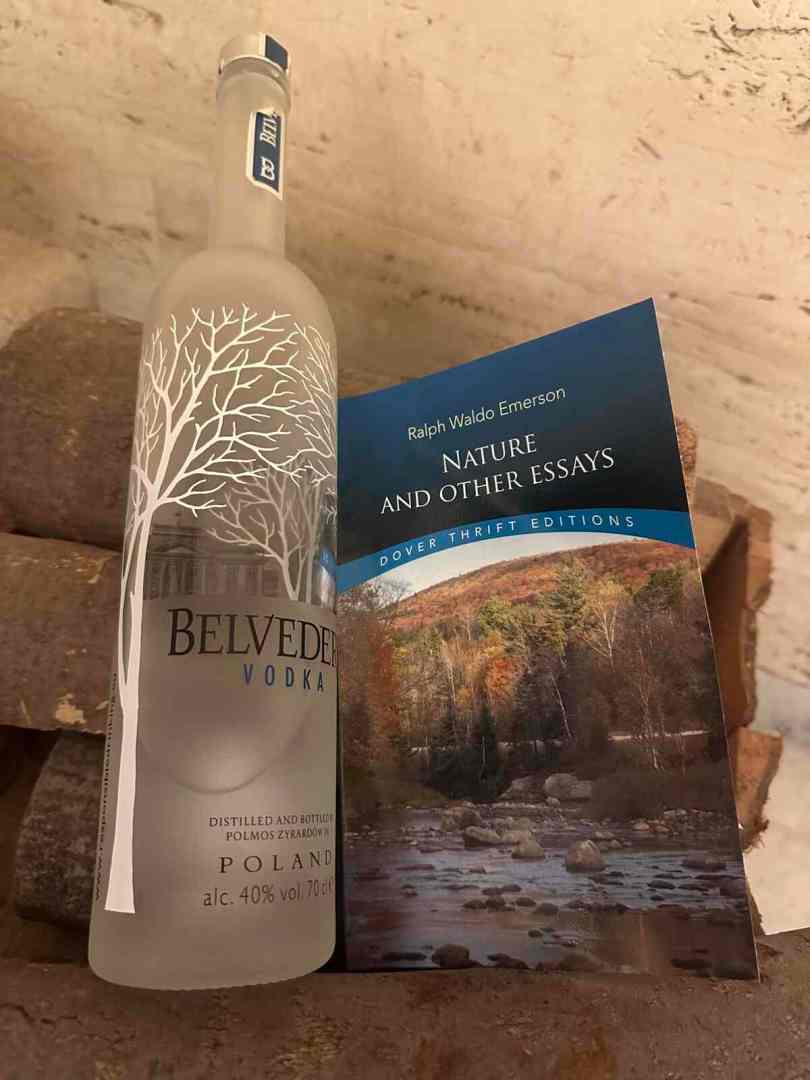
A man is fed, not that he may be fed, but that he may work.
— Ralph Waldo Emerson, “Nature” (1836)
All the facts in natural history taken by themselves, have no value, but are barren like a single sex. But marry it to human history, and it is full of life.
— Ralph Waldo Emerson, “Nature” (1836)
Debt, grinding debt, whose iron face the widow, the orphan, and the sons of genius fear and hate — debt, which consumes so much time, which so cripples and disheartens a great spirit with cares that seem so base, is a preceptor whose lessons cannot be forgone, and is needed most by those who suffer from it most.
— Ralph Waldo Emerson, “Nature” (1836)
Every universal truth which we express in words, implies or supposes every other truth.
— Ralph Waldo Emerson, “Nature” (1836)
The true philosopher and the true poet are one, and a beauty, which is truth, and a truth, which is beauty, is the aim of both.
— Ralph Waldo Emerson, “Nature” (1836)
To the wise, therefore, a fact is true poetry, and the most beautiful of fables.
Boredom makes you do things you never imagined you’d do, like revisiting the works of Kant, for example.
For ten or so days, I’ve been reading Critique of Judgment for absolutely no reason other than “because I picked it up while I was organizing the shelves.”
Honestly, unlike the first time, I did enjoy reading it this time. I wonder why. Is it because I have recently celebrated my 36th birthday? Is enjoying Kant a sign that I am growing old? I’m only half-joking. I’m addicted to philosophy, and, at this point, I’d read anything I can get my hands on.
A drinking buddy once asked me, “Why do you read philosophy?” “To find the answer to the question you just asked,” I responded. We both laughed back then, but, in retrospect, it was a good answer. Imagine people reading philosophy to only understand why people read philosophy. But this has nothing to do with Kant or his Critique of Judgement…
So, let’s start with table that summarizes the first 100 pages or so of the book, shall we?
Comparison table: the agreeable, the beautiful, the sublime, the good
Notes on the comparison table:
I use the phrase “subjectively universal” because Kant uses it. The beautiful is subjectively universal because when a man “declares something to be beautiful, he expects the same delight from others.” Also, because we’re dealing with aesthetics, “there can be no objective rule of taste by which what is beautiful may be defined.”
Purposiveness without a purpose is a phrase that is repeated multiple times in the book. While an object may look like it has an inherent purpose, it may not actually have a purpose. (Look up “German Idealism”).
The Kantian checklist for identifying works of fine art
Now, let’s say we’re dealing with a work of art. How can we know that the piece can be classified as fine art? Based on Kant’s Critique of Judgement, we can create a checklist and ask ourselves the following questions:
Can we say this is the work of a genius (as defined by Kant), of someone who has the technical skills and the innate capacity for artistic creation?
Can we say there’s purposiveness in the work of art without actual purpose?
Are we experiencing a disinterested pleasure, a pleasure that has nothing to do with our personal desires, preferences, or interests?
Are the expressions of the aesthetic ideas beyond our capacity to understand them through concepts?
Does it allow the free play of imagination and understanding?
Does it ask for our reflective judgement and interpretation?
Would the “common sense” in us say that it’s a work of fine art?
Is it original, and does it make us experience something new?
Do we admire it without (or before) knowing why we admire it?
If we’ve answered yes to all (or most) of the above, then we can say that we’re dealing with a work of fine art.
Quotes from Kant’s Critique of Judgement
“Only by what one does heedless of enjoyment, in complete freedom and independently of what nature could passively procure for him, does he give to his life, as the existence of a person, an absolute worth. Happiness, with all its plethora of pleasures, is far from being an unconditioned good.”
“Only when people’s needs have been satisfied can we tell who among the crowd has taste or not.”
“Poetry (which owes its origin almost entirely to genius and is least willing to be led by precepts or example) holds the first rank among all the arts.”
“We are unable, therefore, objectively to substantiate the proposition: There is an intelligent original Being.”
“Now since learning is nothing but imitation, the greatest ability, or aptness as a pupil (capacity), is still, as such, not equivalent to genius.”
Earlier today, I finished reading Giorgio Parisi’s In a Flight of Starlings: The Wonders of Complex Systems. Honestly, I expected it to be a little more potent. If we can compare an Italian scientist to an Italian scientist, it could have at least been as good as Carlo Rovelli’s Helgoland: The Strange and Beautiful Story of Quantum Physics. But it wasn’t.
Yet, Parisi’s book is filled with aha moments. To read it is not a waste of time. The doors open, and we enter the mind of a physicist from the back door. This is what happens behind the scenes. This is how scientists think.
And it seems to me now that all good scientists are somewhat into literature and/or philosophy. The references I come across in their books are enough to prove me right.
So, it turns out, only pseudo-scientists who lack creativity say, “Philosophy is dead.” And their statement can also be considered true because, in them, philosophy is dead.
Reading In a Flight of Starlings reminds us of something we tend to forget: There’s poetry everywhere, even in physics.
Before I close this entry, here are two quotes from Giorgio Parisi’s book:
“The physicist sometimes uses mathematics ungrammatically; not following all the rules of grammar is a license that we grant to poets.”
“In the sciences as in poetry, there is hardly a trace in the finished product of the arduous work that the creative process has demanded, or the doubts and hesitations that have been overcome in order to achieve it.”


 Bored Absurdist