The Perfumery

There was once a perfumery on Hamra Street called Reeha.

Every morning, the owner of the perfumery, a middle-aged man with broad shoulders named Mahmoud El Rashed, and his employee, a middle-aged woman who had long lost her femininity named Tania Boutros, drank coffee in paper cups and smoked cigarettes on the sidewalk in front of the shop.

Other shop owners and salespeople occasionally joined them for small talk; most of the time, however, there would be just the two of them, Mahmoud and Tania, enjoying a form of silence disguised as a conversation.

If a passerby ever chose to listen in, he would think that the two were dynamically engaged in the conversation they were having. What wouldn’t cross his mind, however, is this: Mahmoud and Tania had the exact same conversation every morning for over twenty years. They spoke without thinking and with little awareness of what really came out of their mouths. They were like two actors rehearsing a boring dialogue after a night of heavy drinking. They performed it quite well, but the meaning of their dialogue was overworked and long exhausted. It meant absolutely nothing to them. Their words had become nothing but sound, mantras that were part of the noise of the city, no different than the chirping of the birds and the begging of the beggars. As they spoke mechanically, they traveled freely in their own minds. They were there, but they weren’t there.

“The weather’s not so bad today,” one of them would always say.

“Yes,” the other would agree, “and let’s hope it will get even better tomorrow.”

“Did you see the news last night?” Tania would always ask when she was halfway through her coffee.

“Why would I watch the news?” Mahmoud would answer. “The news has been the same since 1991. Only the reporters have changed.”

Lighting his third and last cigarette before the start of his workday, Mahmoud would ask, “Remind me, Tania, how many perfume bottles did we sell yesterday?”

And Tania would smile and say something like, “Ya Mahmoud. Wallah, the number’s so small that it’s not worth mentioning.”

But this morning was a little different than all preceding mornings. Just a little different. Before they went in, Tania delivered – or, rather, tried her best to deliver –  several jokes she had come across online the night before. This was new. But unfortunately for her, none of the jokes made Mahmoud laugh. In fact, it was so out of their morning routine script that Mahmoud did not know how to react.

“Hamra is dying,” Mahmoud said after a pause. “It has been dying for more than a decade now.”

Da,” Tania responded.

“What’s that?” Mahmoud asked.

Da means yes in Russian,” Tania said.

“Do you speak Russian now?” Mahmoud asked.

“No, I only know this word,” Tania said. “Da.”
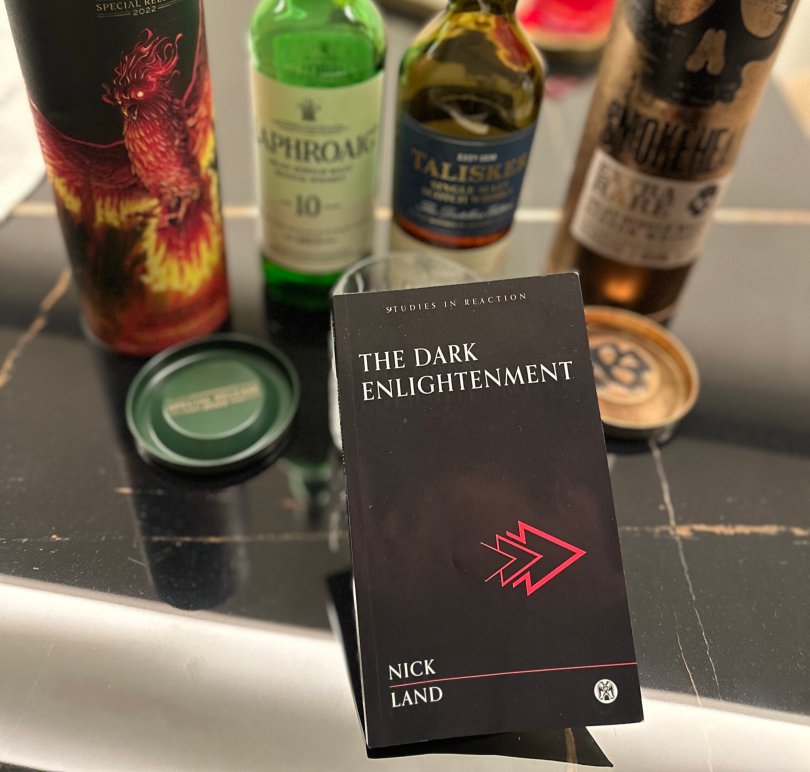
Book Review and Quotes from Nick Land's The Dark Enlightenment

Five Quotes from Nick Land’s The Dark Enlightenment

When I read Nick Land’s The Dark Enlightenment for the first time, I was not impressed by it at all. In fact, I was so disappointed that I commented on it on social media. I wrote, “I expected this book to be more than what it turned out to be. I was expecting the Nietzsche of the 21st century; I got a Hobbesian net surfer instead. Nick Land’s The Dark Enlightenment is the tea time chatter of a person you really don’t want to hang out with. Thankfully, the book is less than 100 pages. The only purpose this book can really serve is as a light commentary on Menius Moldbug’s (Curtis Yarvin’s) blog posts.”

That’s what I said then. So, if it’s so bad, why am I reading it again? Well… There is something so right about it, you see, but I don’t know what it is. (Of course, I do not agree and don’t have to agree with his politics to admire his texts, even if it’s a political text.) The Dark Enlightenment just has this magnetic power that pulls you, makes you want to chew the cud, and — what?

Quote from The Dark Enlightenment

Since winning elections is overwhelmingly a matter of vote buying, and society’s informational organs (education and media) are no more resistant to bribery than the electorate, a thrifty politician is simply an incompetent politician, and the democratic variant of Darwinism quickly eliminates such misfits from the gene pool.

– Nick Land, The Dark Enlightenment

Anarcho-capitalist utopias can never condense out of science fiction, divided powers flow back together like a shattered Terminator, and constitutions have exactly as much real authority as a sovereign interpretative power allows them to have.

– Nick Land, The Dark Enlightenment

Democracy consumes progress.

– Nick Land, The Dark Enlightenment

The left thrives on dialectics, the right perishes through them.

– Nick Land, The Dark Enlightenment

When only tolerance is tolerable, and everyone (who matters) accepts this manifestly nonsensical formula as not only rationally intelligible, but as the universally-affirmed principle of modern democratic faith, nothing except politics remains.

– Nick Land, The Dark Enlightenment

Quote from Soren Kierkegaard's Fear and Trembling

Quotes from Soren Kierkegaard’s Fear and Trembling

Here are five great quotes from Kierkegaard’s Fear and Trembling:

One became great through expecting the possible, another by expecting the eternal; but he who expected the impossible became greater than all.

– Soren Kierkegaard, Fear and Trembling

Whatever one generation learns from another, it can never learn from the predecessor the genuinely human factor. In this respect every generation begins afresh, has no task other than that of any previous generation, and comes no further, provided the latter didn’t shirk its task and deceive itself.

– Soren Kierkegaard, Fear and Trembling

Fools and young people talk about everything being possible for a human being. But that is a great mistake. Everything is possible spiritually speaking, but in the finite world there is much that is not possible.

– Soren Kierkegaard, Fear and Trembling

All that can save him is the absurd; and this he grasps by faith.

– Soren Kierkegaard, Fear and Trembling

No person who has learned that to exist as the individual is the most terrifying thing of all will be afraid of saying it is the greatest.

– Soren Kierkegaard, Fear and Trembling