Notes and Quotes from Adorno and Horkheimer's Dialectic of Enlightenment

On Art and Advertisement: Notes and Quotes from Dialectic of Enlightenment

Reading Dialectic of Enlightenment made me accept the sad reality that truly autonomous works, whether artistic or philosophical, are made invisible or infertile by the system.

The artist or philosopher has to first sacrifice his originality (i.e., individuality) to be allowed to enter the field he wants to play in. He has to follow the rules of the game and, occasionally, to refresh the dynamic, (pretend to) break some rules that are pre-approved to be broken by the culture industry. The artist, for instance, to become an artist, must allow his spirit to flow through the workflow (and be shaped by the standards) set by the culture industry, which either approves, absorbs, or marginalizes the works produced. As Adorno and Horkheimer put it, “The whole world is made to pass through the filter of the culture industry.” (So, if you dream on becoming an artist, first get the checklist provided by the culture industry, and then get to work.)

Secondly, it is not enough for the artist (or philosopher) to produce works digestible by the system; one must also self-advertise as self-advertising (in our hyperreal universe) is the underlying premise of existence. When one exits or stops posting on social media, he simply ceases to exist. Without self-advertising, no matter how great or unique one’s voice is, it won’t be heard. (The system is asking, “If you don’t believe in yourself enough to brag and boast about your works, how can you expect others to accept who you’re claiming to be?”)

And unfortunately, my dear friend, the sad reality’s borders extend even farther. It isn’t enough to go through the system submissively and then advertise the (pre-approved) creative work that you produced. No… By the time you get there, you’ll find out that art has been commodified and, therefore, art is no longer art. It’s a mere (entertaining) product that is advertised to be sold. No matter what your art is trying to communicate, there will be a price tag on it and that will be its true value. Other than what the artwork pretends to be saying, what today’s art is screaming is nothing other than, “Please buy me!”

Even “art for art’s sake” is dead.

The (real) art in the culture industry is not art, it is advertisement.

Quotes from Dialectic of Enlightenment

Not to conform means to be rendered powerless, economically and therefore spiritually — to be “self-employed.”

– Adorno & Horkheimer, Dialectic of Enlightenment

Not only are the hit songs, stars, and soap operas cyclically recurrent and rigidly invariable types, but the specific content of the entertainment itself is derived from them and only appears to change. The details are interchangeable.

– Adorno & Horkheimer, Dialectic of Enlightenment

The triumph of advertising in the culture industry is that consumers feel compelled to buy and use its products even though they see through them.

– Adorno & Horkheimer, Dialectic of Enlightenment
Book Review and Quotes from Atul Gawande's Being Mortal

Notes and Quotes from Atul Gawande’s Being Mortal

This morning, I spent some time reorganizing my bookshelves before the start of my workday. Reorganizing my books relaxes me. It’s like a mindfulness session, if you know what I mean. So, sometimes, I do it for that reason alone.

When I picked up Atul Gawande’s Being Mortal: Medicine and What Matters in the End, I began to flip through its pages and went on reading the sentences I had underlined years ago. I remember loving the book. I remember reading it back when I was “studying” death: What is the meaning of death? How does the awareness and the fear of death affect us? What is the death instinct? How does one prepare to die? Etc. Besides the classics like Ernest Becker’s The Denial of Death and Sigmund Freud’s Beyond the Pleasure Principle, Gawande’s Being Mortal was one of the books I ended up reading.

Being Mortal talks about aging and the inevitable conclusion of life. More precisely, it talks about what medicine can do about these inescapable realities.

Here I am now, sharing, for no particular reason and after so many years, some of the sentences I had underlined, and they are not necessarily about death…

First Quote

Nothing that takes off becomes quite what the creator wants it to be. Like a child, it grows, not always in the expected direction.

– Atul Gawande, Being Mortal

I like this quote because it can live outside the book it was created for. Even when used out of context, it still delivers a philosophical insight. In a way, it does not need its surrounding words; on the contrary, its surrounding words become more meaningful when it is added to them… So, let us take this quote and walk out of the book for a moment. Doesn’t it make us want to ask the following: Can the creation transcend what it was created for? And is not the answer a resounding yes? Think about it.

Second Quote

The only way death is not meaningless is to see yourself as part of something greater: a family, a community, a society. If you don’t, mortality is only a horror. But if you do, it is not.

– Atul Gawande, Being Mortal

Aloneness will, sooner or later, swallow us whole if we don’t chain ourselves to an idea that is larger than life. One cannot live a fulfilling life without believing in something. As they say, a good reason to live for is simultaneously a good reason to die for.

Third Quote

All we ask it to be allowed to remain the writers of our own story. That story is ever changing. Over the course of our lives, we may encounter unimaginable difficulties. Our concerns and desires may shift. But whatever happens, we want to retain the freedom to shape our lives in ways consistent with our character and loyalties.
This is why the betrayals of body and mind that threaten to erase our character and memory remain among our most awful tortures.

– Atul Gawande, Being Mortal

Gawande repeats this idea in different parts of the book. I’d even say that he repeats it more poetically elsewhere. Don’t worry, however; the quote I chose delivers the message clearly. What Gawande keeps communicating throughout the book is that life becomes meaningful when it feels like a story. When you lose chapters of your story or when you’re no longer able to connect the dots of your self, life loses its meaning. Life doesn’t only end when one’s story ends. Life also (figuratively) ends when it ceases being a story.

Fourth Quote

Patients tend to be optimists, even if that makes them prefer doctors who are more likely to be wrong.

– Atul Gawande, Being Mortal

This is already observable with the naked eye: A person has the tendency to prefer the flatterer over the critic. But those who plan on becoming better, must eventually leave behind the former and listen to the latter.

5 quotes from Aldous Huxley's Ape and Essence

Quotes from Aldous Huxley’s Ape and Essence

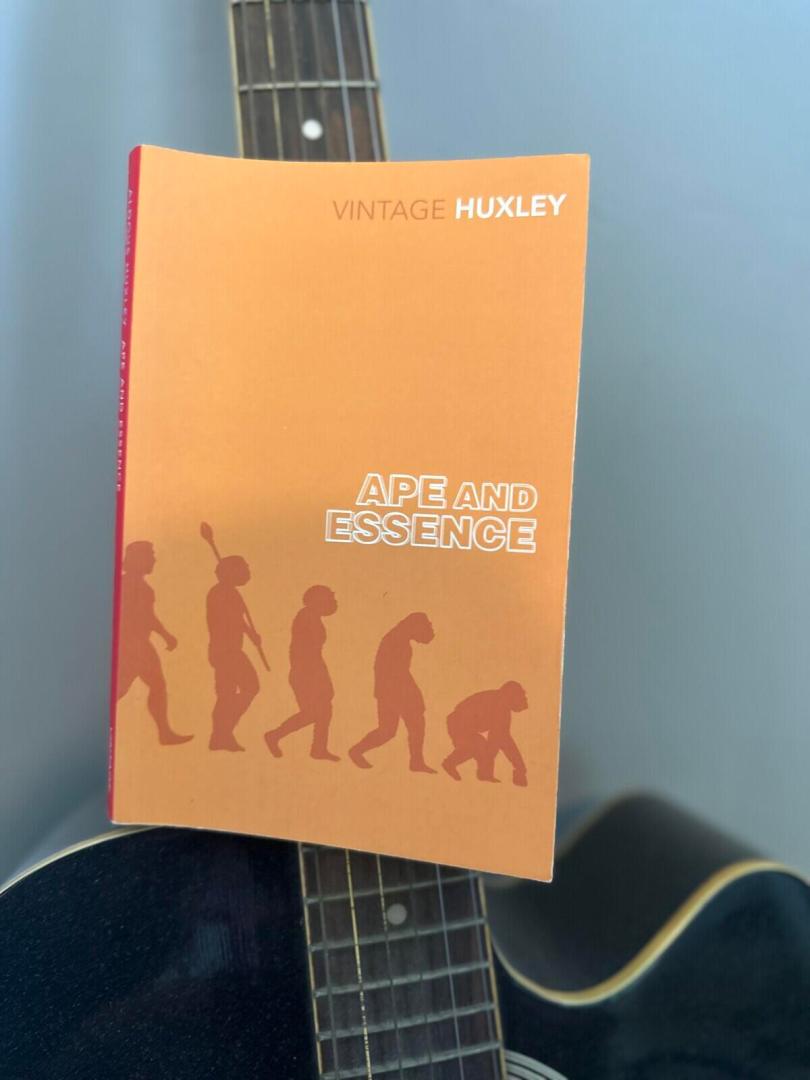
About five years ago, browsing around a bookshop, I stumbled across Aldous Huxley’s Ape and Essence. Of course, I was familiar with Huxley and a bunch of his works, such as Brave New World, The Doors of Perception, and Music at Night. But I had never heard of Ape and Essence before. So, I picked it up, read its synopsis, and a few random sentences from random pages. “This smells like a delicious dystopian novel,” I whispered to myself. And, to no one’s surprise, I ended up buying it. And I enjoyed reading it very, very much. (So, if you’re into dystopian literature like I am, make sure you read this one, too.)

Here are five quotes from Aldous Huxley’s Ape and Essence:

In the field of politics the equivalent of a theorem is a perfectly disciplined army; of a sonnet or picture, a police state under a dictatorship.

– Aldous Huxley, Ape and Essence

But I was thinking that the dream of Order begets tyranny, the dream of Beauty, monsters and violence.

– Aldous Huxley, Ape and Essence

Yes, my friends, remember how indignant you once felt when the Turks massacred more than the ordinary quota of Armenians, how you thanked God that you lived in a Protestant, progressive country, where such things simply couldn’t happen — couldn’t happen because men wore bowler hats and travelled daily to town by the eight-twenty-three.

– Aldous Huxley, Ape and Essence

They have to be punished for having been punished.

– Aldous Huxley, Ape and Essence

And whenever evil is carried to the limit, it always destroys itself.

– Aldous Huxley, Ape and Essence