Quotes from The Communist Manifesto

We cannot but acknowledge that the specter of communism still haunts the world, that it never stopped haunting it. The collapse of the Soviet Union wasn’t the end of communism, nor, as some would argue, was its establishment the beginning.

All historians without exception agree, I hope, that the first half of the 20th century wasn’t really the best of times. On a scale of one to what-the-hell-are-you-doing, it was the worst period in human history. That’s when the ‘communism’ you are afraid of today was born.

Communism itself does not advocate killing, of course. (Nor does it want you to be hungry and poor, by the way.) Lenin, fighting in the name of communism, however, did not shy away from spilling some blood. But that’s not so surprising, I would say. When the revolution comes, people die. That’s how it always has been.

On the other hand, we must also understand that though people (like Dostoevsky, for example) were afraid of communism (or socialism, or anarchism) way before 1917, it was only after the October Revolution that the bourgeoisie shat in their pants. As Orlando Figes puts it in Revolutionary Russia, 1891-1991, “It was not Marxism that made Lenin a revolutionary but Lenin who made Marxism revolutionary.” In other words, Karl Marx wouldn’t have sent so many people to the Gulag as Lenin, or as Stalin, did.

Now, since I have just reread The Communist Manifesto, and since communism and anti-communism is still a thing on Social Media, here are some quotes from it. Maybe you’ll use one of them to win an argument one day. Who knows?

The history of all hitherto existing society is the history of class struggles.

The distinguishing feature of communism is not the abolition of property generally, but the abolition of bourgeois property.

The bourgeoisie cannot exist without constantly revolutionizing the instruments of production.

Communism deprives no man of the power to appropriate the products of society; all that it does is to deprive him of the power to subjugate the labour of others by means of such appropriation.

But not only has the bourgeoisie forged the weapons that bring death to itself; it has also called into existence the men who are to wield those weapons – the modern working class – the proletarians.

Now and then the workers are victorious, but only for a time. The real fruit of their battles lies, not in the immediate result, but in the ever expanding union of the workers.

The “dangerous class,” the social scum, that passively rotting mass thrown off by the lowest layers of old society, may, here and there, be swept into the movement by a proletarian revolution; its conditions of life, however, prepare it far more for the part of a bribed tool of reactionary intrigue.

The communists have not invented the intervention of society in education; they do but seek to alter the character of that intervention, and to rescue education from the influence of the ruling class.

The proletarian movement is the self-conscious, independent movement of the immense majority, in the interest of the immense majority.

That’s it for today.

Chris Khatschadourian Reading Thoreau's Civil Disobedience

Quotes from Thoreau’s “Civil Disobedience”

I read Henry David Thoreau’s “Civil Disobedience” (1849) wholeheartedly for the first time a little before I started participating in the Lebanese protests of 2015. That was the year I became aware that I am a political animal.

Then I reread it in 2017 (I know this because I posted a picture of the book on my Instagram page with a description that says, “Getting ready for #revolution on Monday morning.”), and I read it once more today, a week after the Beirut Explosion which took place on August 4, 2020.

“Civil Disobedience” unintentionally turned me into some sort of an anarchist — “That government is best which governs not at all.”

But most importantly, Thoreau made me realize that when a government is corrupt, incompetent, or simply inefficient, one must not remain silent. You must fight for what’s right, even if the majority is against you. “For it matters not how small the beginning may seem to be: what is once well done is done for ever.”

Quotes from Thoreau’s “Civil Disobedience”

I heartily accept the motto, — “That government is best which governs least;” and I should like to see it acted up to more rapidly and systematically. Carried out, it finally amounts to this, which I also believe, — “That government is best which governs not at all;” and when men are prepared for it, that will be the kind of government which they will have.

Henry David Thoreau, “Civil Disobedience” (1849)

Unjust laws exist: shall we be content to obey them, or shall we endeavor to amend them, and obey them until we have succeeded, or shall we transgress them at once? Men generally, under such a government as this, think that they ought to wait until they have persuaded the majority to alter them. They think that, if they should resist, the remedy would be worse than the evil. But it is the fault of the government itself that the remedy is worse than the evil. It makes it worse.

Henry David Thoreau, “Civil Disobedience” (1849)

All men recognize the right of revolution; that is, the right to refuse allegiance to and to resist the government, when its tyranny or its inefficiency are great and unendurable. But almost all say that such is not the case now.

Henry David Thoreau, “Civil Disobedience” (1849)

All voting is a sort of gaming, like chequers or backgammon, with a slight moral tinge to it, a playing with right and wrong, with moral questions; and betting naturally accompanies it. The character of the voters is not staked. I cast my vote, perchance, as I think right; but I am not vitally concerned that that right should prevail. I am willing to leave it to the majority.

Henry David Thoreau, “Civil Disobedience” (1849)

There is but little virtue in the action of the masses of men.

Henry David Thoreau, “Civil Disobedience” (1849)

Any man more right than his neighbors constitutes a majority of one already.

Henry David Thoreau, “Civil Disobedience” (1849)
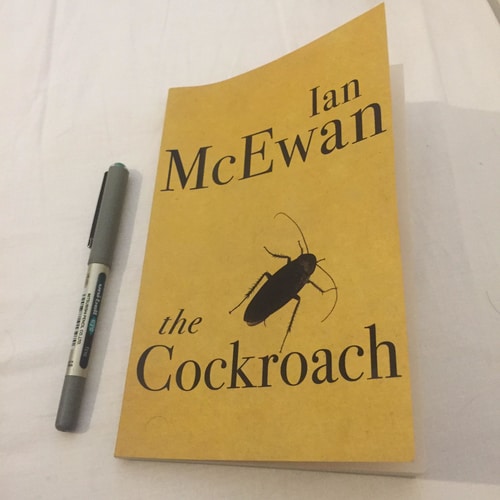
The Cockroach by Ian McEwan Book Review

The Cockroach by Ian McEwan (Review)

After reading the opening lines of Ian McEwan’s The Cockroach, I was immediately, and expectedly, reminded of Kafka’s “Metamorphosis.” The initial pages of the book are, broadly put, “Metamorphosis” inverted. However, even though Kafka readers will positively be entertained reading McEwan’s work, the story itself is not Kafkaesque — we do not really feel that we are in one of Kafka’s nightmares. Jim Sams, the main character of The Cockroach, is not ‘struck by the absurd,’ as Albert Camus would have put it. Moreover, the story’s aim is not to answer, “What would happen if a cockroach turns into a man?”  That’s merely the first 15 or so pages of the book. After that, The Cockroach crosses the perimeters of “The Metamorphosis” to become something else — a political satire.

There are significant differences between Jim Sams of The Cockroach and Gregor Samsa of “Metamorphosis,” but one of the differences is much more significant than the rest. When Gregor Samsa is metamorphosed into an insect, he is still the same person. He does not adopt the insect’s character, its mind, or its memories. On the other hand, when Jim Sams becomes human, he remembers who he was as a cockroach — he is still himself — but he also has access to the mind and memories of the human body he now pilots. But that’s not all. The story becomes more interesting (and frightening) when we discover that the cockroach who now controls the human body of Britain’s prime minister has a political agenda.

Jim Sams wants to transform Britain into a ‘Reversalist’ country. We are introduced to the concept of ‘Reversalism’ in the second chapter of the book. Concisely, it means reversing the money flow. “At the end of a working week, an employee hands over money to the company for all the hours that she has toiled. But when she goes to the shops, she is generously compensated at retail rates for every item she carries away.” And Jim Sams does everything in his power to achieve that.

Overall, McEwan’s The Cockroach is a good book to read, whether you have read Kafka’s “Metamorphosis” or not.  However, I think that the people who will enjoy this book most are the ones who are familiar with things like Donald Trump and his Twitter account, Brexit, the Me Too movement, et cetera.